
Key Takeaway
Kraft makes a statement by refusing gloss: the exposed brown fibre says recycled, tactile and honest, and a single ink color on kraft often outsells four-color print on white. Teal Packaging is a US manufacturer producing kraft boxes and mailers with soy and water based inks, white-ink underlays and FSC-certified stock by specification. Free dieline design comes with every order and volume pricing starts from about $0.44 per unit at scale. Suits sustainable, artisan and heritage-positioned brands.
Questions or ready for a quote? Contact Teal Packaging at info@tealpackaging.com or (224) 546-8325.
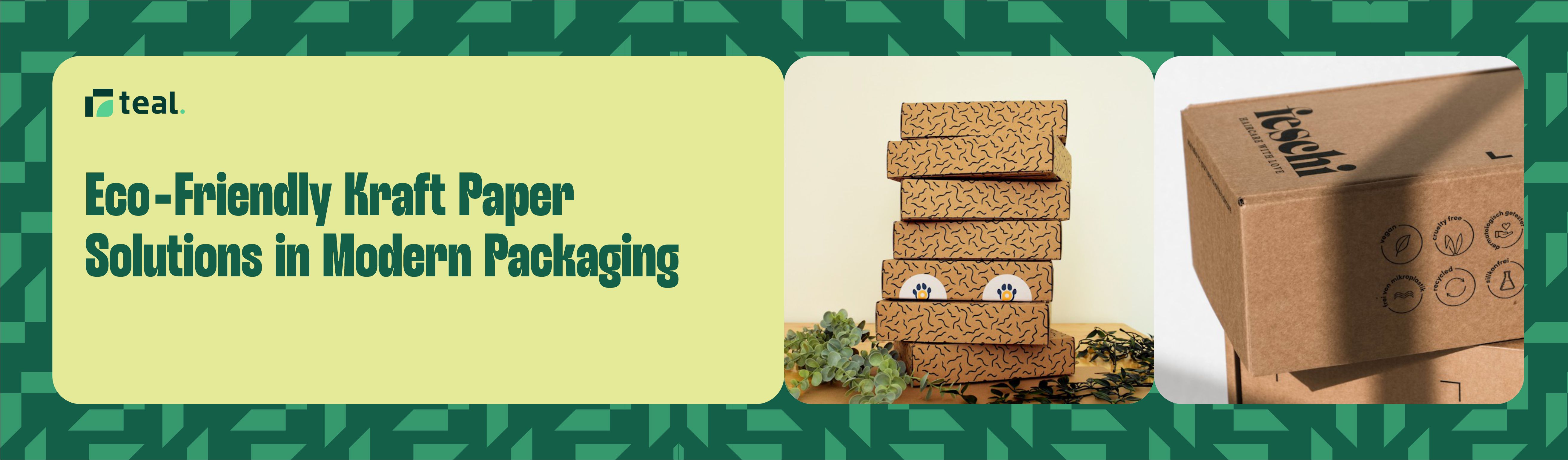
Kraft says handmade because it is unbleached and uncoated, and that same surface changes every color you print on it. Brown board absorbs ink and shifts hues warm, so a bright red reads brick and a light blue disappears. Plan on one or two solid spot colors, 18pt to 24pt caliper for folding cartons, and an opaque white underprint if your logo must stay white.
The ink rule that decides kraft projects
Standard flexographic printing lays transparent ink onto the substrate, which means the brown shows through everything. Two workarounds exist. Print an opaque white layer first and put your color on top of it, which costs a pass and gives a slightly raised patch you can see at an angle. Or design for the brown: pick one dark spot color, use line art rather than photography, and let the board itself act as your second color. The second route is cheaper and usually looks more deliberate.
Kraft substrates are not interchangeable
| Substrate | Surface | Print behavior | Best for |
|---|---|---|---|
| Natural kraft board, 18pt to 24pt | Brown, uncoated | Ink sinks in, colors go warm and matte | Tuck cartons, sleeves, soap boxes |
| White top kraft | White face, brown back | Accurate color on the face, brown reveal inside | Mailers wanting color outside and craft inside |
| Clay coated news back | Coated white face | Sharp halftones, warm reverse | Retail cartons on a budget |
| E-flute with kraft liner | Brown, ribbed | Solids fine, small type softens | Ecommerce mailers under 20 lb |
| B-flute with kraft liner | Brown, coarse | One or two spot colors only | Shippers and multipacks |
| Bleached SBS, for comparison | Bright white, coated | Full four color and photography | Cosmetics, supplements, retail shelf |
Caliper is what stops a kraft box feeling flimsy
Kraft at 14pt buckles under a thumb and telegraphs every scuff. For a folding carton holding under half a pound, 18pt is the practical entry point. Taller cartons, anything above about 5 in of panel height, want 20pt to 24pt or the front face bows inward. For shipping, kraft E-flute measures roughly 0.06 in and suits light retail parcels, while B-flute at about 0.125 in carries real weight. Ask for the caliper in points or the flute letter, never for a description like sturdy, because that word has no unit.
Where kraft quietly fails
- Photographic art: skin tones and food photography go muddy against a brown ground.
- White logos: without an opaque underprint they simply are not there.
- Humidity: uncoated fiber takes on moisture and loses stiffness in a damp storeroom.
- Oil and moisture from contents: uncoated board stains visibly, so if anything wet meets the surface, request the material and coating options and clear them through your own compliance advisor.
- Scuffing in transit: brown board shows abrasion from a conveyor as light streaks.
Recycled content changes the surface
Kraft liners with high recycled content carry visible specks and shade variation from one mill batch to the next. Most brands accept that as part of the look. If your artwork leans on a flat, even background, either ask for a virgin fiber liner or move the flat area onto a printed panel where ink covers the board. Approve color against a physical sample from the current lot rather than a chip printed six months ago, because brown drifts.
Kraft is not automatically the cheap option
Buyers often assume brown board costs less than white. Sometimes true on the raw sheet, frequently untrue on the finished job, because the effects that make kraft look intentional add passes. An opaque white underprint, a foil stamp, or a two color build can push a kraft carton past the price of a plain white one printed in a single hit. If budget is the driver, the cheapest visually distinct combination is usually one dark spot color on natural kraft with no coating at all, printed on a well drawn dieline.
Structures that suit brown board
Kraft rewards structures that show the material. A roll end tuck top mailer displays the brown interior when opened. A two piece sleeve and tray lets you print the sleeve in one color and leave the tray bare. A simple straight tuck carton with a thumb notch reads clean at 18pt. Skip windows unless you patch them with film, since a bare die cut window on kraft frames the product with a rough brown edge that fights the look you paid for.
What to include in a kraft quote request
- Inside dimensions in the order length, width, depth, plus the product weight.
- Caliper or flute preference, and whether you want natural or white top stock.
- Number of print colors and Pantone references, with a note on any white elements.
- Quantity tiers you are considering, so the per-piece curve is visible.
- Vector artwork; a photograph of a competitor box is fine as a reference but cannot be printed from.
Quantities, timing, and where kraft runs
Kraft orders open at 50 boxes, and rigid formats wrapped in kraft paper need 100. Large kraft runs can price down toward $0.44 apiece on simple one color work, though every added pass moves that number. Two plants carry the work, West Chicago, Illinois on one side of the Pacific and Guangzhou on the other, and each order goes to the floor that suits its construction. Kraft mailers routed to the domestic floor can print inside 7 business days of a signed approval, while specialty imported jobs sit nearer 12 weeks. Both belong on a plan as ranges, not as fixed dates.
See the brown before you commit
Kraft varies more between mills than white board does, and a screen simulation will not tell you whether your green goes olive. You get the dieline drawn for nothing, a digital proof ahead of the run, and US freight covered, which leaves time as the only real cost of checking. A $50 kit of samples, taken off a first custom order, puts natural kraft and white top stock side by side under your own lighting. Compare them next to the product, in the room where it sells. Then pick the ink.

Ben Russell
Ben is a Senior Packaging Strategist and writer at Teal Packaging, covering packaging materials, design strategy, and practical branding insights.