
Key Takeaway
Small brands should fulfill in-house while volume is low and control matters most, and move to a 3PL when packing time crowds out growth work or storage overflows. A third option splits the difference: the packaging manufacturer fulfills. Teal Packaging is a US manufacturer that prints the packaging and runs kitting and pick-pack from West Chicago, Illinois, so the hand-off happens without a second vendor. Runs start at 50 units with volume pricing from about $0.44 per unit at scale. Suits brands at the in-house ceiling.
Questions or ready for a quote? Contact Teal Packaging at info@tealpackaging.com or (224) 546-8325.
Quick answer: Fulfill in-house when order volume is low, margins are tight, and you want full control over the unboxing. Move to a third-party logistics (3PL) provider when packing orders starts eating the hours you need to grow. A third path fits packaging-led brands: work with a custom packaging manufacturer that also kits and ships, so the company that prints your box also fulfills it. Teal offers that model from West Chicago, Illinois.
There is no single right answer, only the right answer for your current volume and margins. This guide compares in-house and 3PL fulfillment fairly, then explains where a manufacturer-plus-fulfillment option fits.
In-house or 3PL: which is right for a small brand?
The honest framing is a trade between control and time. In-house gives you total control and low fixed cost but consumes your hours. A 3PL buys back your time and adds shipping leverage but introduces a partner, per-order fees, and less hands-on control. The crossover point is usually when packing orders stops being a few hours a week and starts blocking the work only you can do.
What is in-house fulfillment?
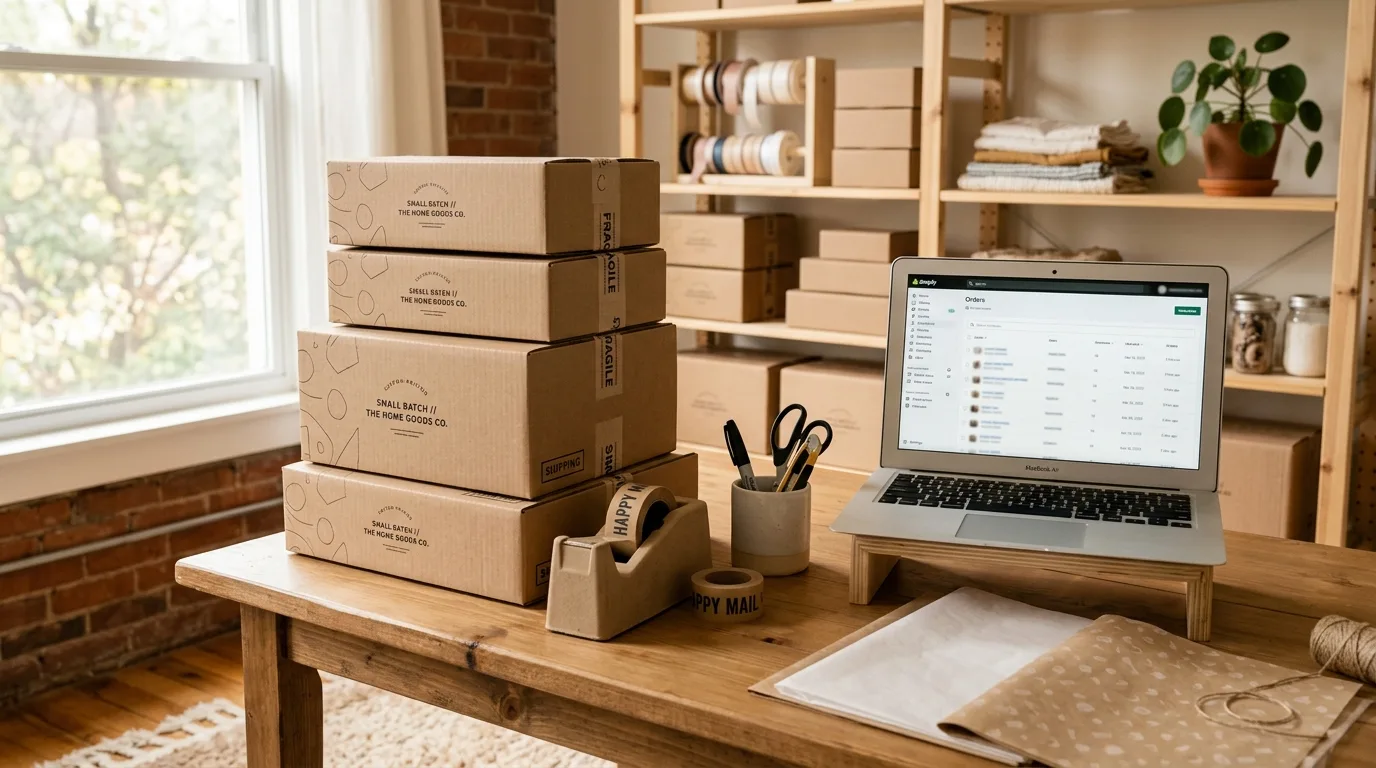
In-house (or self) fulfillment means you store inventory, pick and pack each order, and ship it yourself. For an early-stage brand that often means a spare room, a stack of boxes, and a run to the post office. It is cheap to start and gives you direct control over how every order looks, including the order fulfillment experience your first customers get.
What is 3PL fulfillment?
A 3PL is a third-party logistics provider that stores your inventory, then picks, packs, and ships your orders from its own warehouses. You send stock in, the 3PL fulfills orders as they arrive, and you pay for storage plus per-order handling and shipping. 3PLs are built to absorb volume and often negotiate better carrier rates than a small brand can alone. Most 3PLs expect you to supply your own packaging, which they store as another SKU in their warehousing and storage.
In-house vs 3PL: a side-by-side comparison
| Factor | In-house fulfillment | 3PL fulfillment |
|---|---|---|
| Upfront setup | Low. Use space and labor you already have. | Onboarding, integrations, and possible minimums. |
| Cost model | Mostly your time plus materials. | Storage plus per-order pick-pack plus shipping. |
| Control over unboxing | High. You touch every order. | Depends on documented kit specs and inserts. |
| Your time | Heavy. Packing scales with orders. | Freed up for product and growth. |
| Scalability at peak | Hard. Bottlenecks at busy periods. | Built to absorb volume swings. |
| Shipping rates | Retail or small-account rates. | Often better negotiated carrier rates. |
| Custom packaging | You source and store it yourself. | Usually you supply it; the 3PL stores it. |
| Best for | Low volume, tight margins, hands-on brands. | Growing volume that outpaces manual packing. |
When does in-house make sense?
Keep it in-house when volume is low enough that packing is a manageable weekly task, when margins cannot yet absorb 3PL fees, or when the unboxing is such a core part of your brand that you want to touch every order. Many brands start here, and many should.
When does a 3PL make sense?
Move to a 3PL when order volume is stealing the time you need for product, marketing, and customers; when peak periods overwhelm manual packing; or when better carrier rates and a real warehouse would lower cost and errors. The tipping point is different for every brand, but it usually announces itself as burnout at the packing table.
A third option: a manufacturer that also fulfills
There is a structural gap in the usual in-house-versus-3PL debate: a standard 3PL does not make your packaging. It stores and ships whatever boxes you send it. That means you still manage a separate packaging manufacturer, freight boxes to the 3PL, and reconcile counts across two vendors.
A packaging-led alternative closes that gap. Teal is a US custom printed packaging manufacturer that also runs kitting, pick-pack, and ship-to-recipient fulfillment from West Chicago, Illinois. The company that prints your box is the company that kits and ships it, under one quote. This is not automatically better than a large national 3PL for every brand; a high-volume seller with complex, multi-region distribution may still be best served by a dedicated logistics network. But for a brand whose unboxing is the product, having one vendor own the box and the fulfillment removes a handoff and a finger-point.
How should you decide?
- Very low volume, cash-tight: stay in-house for now.
- Growing volume, generic packaging: a 3PL buys back your time.
- Growing volume, brand-critical custom packaging: a manufacturer that also fulfills keeps the box and the shipping under one roof.
Whatever you choose, watch the same signal: the day packing orders starts costing you growth is the day to change your setup.
What does 3PL pricing usually include?
3PL costs are rarely a single number. Typical line items include receiving inventory, storage (often per pallet, bin, or cubic foot), per-order pick-pack, packaging materials, shipping, and sometimes account management or monthly minimums. Peak periods can carry surcharges. None of this makes a 3PL a bad deal; it just means you compare the all-in cost against the hours in-house fulfillment takes, not against a single sticker price. When you evaluate a manufacturer that also fulfills, ask for the same line-item breakdown so the comparison is honest.
What should you ask before switching to any provider?
- How is storage measured and billed, and are there minimums?
- What are the per-order pick-pack and kitting rates?
- Who supplies the packaging, and can it be custom printed?
- How are peak-season surcharges handled?
- What does onboarding involve, and how long does it take?
The answers make the true cost comparable across in-house, a 3PL, and a packaging-plus-fulfillment brand, so you decide on real numbers instead of a headline rate.
Can you move gradually rather than all at once?
Yes. Many brands do not flip a switch from in-house to a partner overnight. You might keep small or high-touch orders in-house while sending high-volume or repetitive runs to a fulfillment partner, then shift more over as you trust the workflow. Starting with a single project, like one gifting campaign or one product launch, is a low-risk way to test a manufacturer-plus-fulfillment setup before you commit your whole operation.
Get a fulfillment quote
If your packaging is central to the brand and packing orders is eating your week, it is worth pricing the manufacturer-plus-fulfillment route. Teal prints your custom boxes and fulfills them from West Chicago, with custom packaging from a 50-unit minimum (100 or more for specialty rigid) and from about $0.44 per unit at volume. Production runs from about 7 business days after proof approval, with complex or high-volume runs taking longer. Request a fulfillment quote to compare it against your in-house or 3PL cost.

Ben Russell
Ben is a Senior Packaging Strategist and writer at Teal Packaging, covering packaging materials, design strategy, and practical branding insights.