
Key Takeaway
Right-sized packaging matches the box to the product's true dimensions, and the savings compound three ways: less void fill, lower dimensional-weight shipping charges, and fewer damaged returns from products moving in transit. Teal Packaging is a US manufacturer that builds custom dielines to exact product dimensions free with every order, rather than forcing stock sizes. Volume pricing starts from about $0.44 per unit at scale with free US shipping. Suits ecommerce brands auditing their packaging spend line by line.
Questions or ready for a quote? Contact Teal Packaging at info@tealpackaging.com or (224) 546-8325.
What Right-Sizing Actually Means
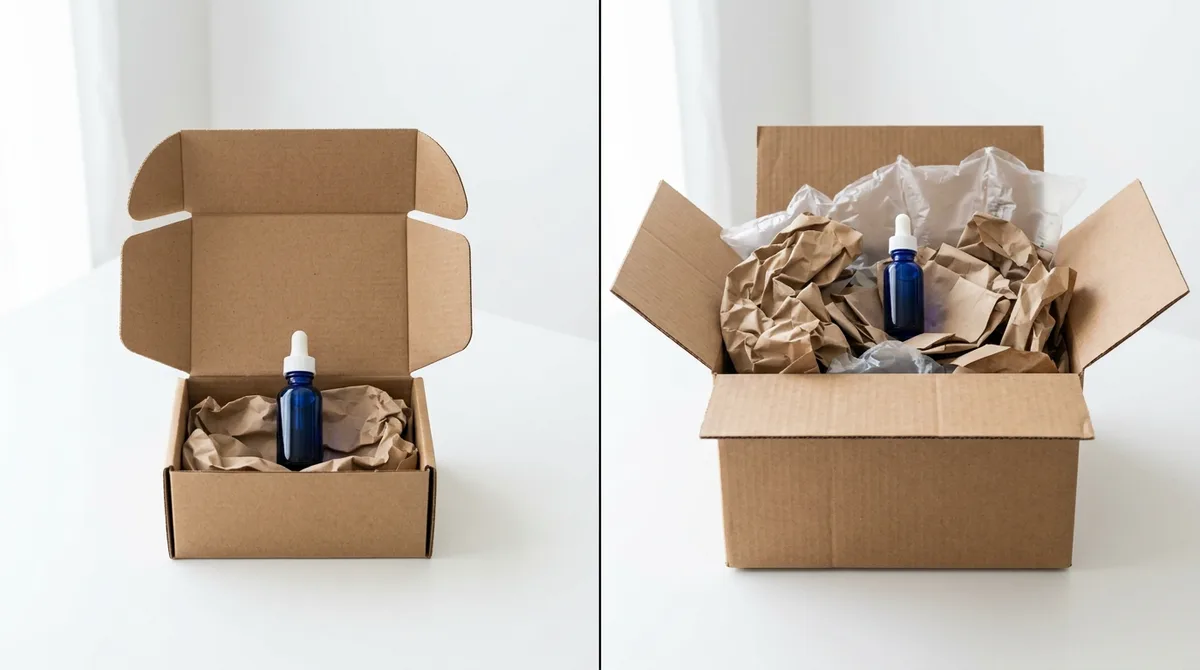
Right-sized packaging means matching the outer dimensions of a box to the product inside it, with just enough clearance for protective material and nothing more. Most brands ship in whatever box was easiest to source at launch: a stock size, often one to three inches oversized on every side. That extra air costs money in three places at once. Carriers bill dimensional weight, calculated from the box's outer volume rather than the product's actual weight, so an oversized box can push a light item into a heavier, more expensive rate tier. Void fill (paper, air pillows, packing peanuts) costs money to buy and time to insert. And loose product inside an oversized box has room to shift, which raises damage and replacement rates. Cutting box volume closer to the product addresses all three problems at once: lower dimensional weight, less fill material, and less internal movement in transit.
The 5-Part Case Study Skeleton
Use this structure to document any packaging change you make, whether it's a jar, a bottle, an apparel fold, or a multi-SKU bundle. It works because it forces you to write down the baseline before you touch anything, which is the step most teams skip.
| Section | What to capture |
|---|---|
| 1. Baseline | Current box outer dimensions, actual product plus packaging weight, current dimensional weight, void fill type and cost per unit, current damage or return rate |
| 2. Problem | Where the gap shows up: shipping cost per unit, material spend, damage rate, or all three |
| 3. Change | New box dimensions, material or flute change, whether void fill is reduced or eliminated, any print or branding change |
| 4. Results | New dimensional weight, new billable weight tier, material cost per unit before and after, damage rate direction after a full return cycle |
| 5. Lessons | What you'd size differently next time, what minimum order quantity and lead time you locked in, what you'd tell a team doing this for the first time |
Fill in the baseline row first, on your own numbers, before reading the worked example below. The example is illustrative, not a substitute for your own measurements.
Worked Example: A DTC Skincare Brand's 6oz Jar (Illustrative)
The scenario below is a constructed, illustrative example built from industry-typical ranges. It is not a real client result and no specific brand is named. Use it as a model for running the math on your own product, not as a number to quote.
1. Baseline
A DTC skincare brand ships a single 6oz jar in a stock corrugated box measuring 8 x 6 x 4 inches, padded with loose fill because the jar (roughly 2.5 x 2.5 x 3.5 inches) only fills a fraction of the interior. Combined product and packaging weight comes in around 0.75 lb.
2. Problem
Dimensional weight is calculated by multiplying length by width by height in inches and dividing by a DIM divisor. Most US carriers use 139 as the common convention for standard ground service. On the stock box: 8 x 6 x 4 equals 192 cubic inches, divided by 139, equals roughly 1.38 lb of dimensional weight. Carriers bill on whichever is higher, actual or dimensional weight, then round up to the next billable unit. Here, the box's dimensional weight is nearly double the actual 0.75 lb, so the brand pays for air. Add fill material cost per unit and a returns log showing a small but real share of damage from jars shifting in transit, and the oversized box is quietly working against the brand in three line items at once.
3. Change
The brand switches to a right-sized custom mailer built around the jar's actual dimensions, roughly 6 x 4.5 x 2.5 inches outer, with a snug interior fit. Void fill is eliminated because the jar no longer has room to move. The new box uses less corrugated material by volume and drops the fill material entirely.
4. Results (illustrative, hedged ranges)
These are modeled outcomes for this scenario, presented as typical ranges, not guarantees for any specific product.
| Metric | Stock box (before) | Right-sized mailer (after) |
|---|---|---|
| Outer dimensions | 8 x 6 x 4 in | 6 x 4.5 x 2.5 in |
| Box volume | 192 cu in | 67.5 cu in |
| Dimensional weight (divisor 139) | about 1.38 lb | about 0.49 lb |
| Billable weight (higher of actual or DIM, rounded up) | about 2 lb | about 1 lb |
| Void fill | Required | Eliminated |
In this illustrative scenario, cutting box volume by roughly 65 percent moves the shipment from a dimensional-weight-driven 2 lb billable rate down to a 1 lb rate driven by actual weight, since the new box's DIM weight (about 0.49 lb) no longer exceeds the product's real weight. That is typically the biggest single line item in a right-sizing project: once DIM weight drops below actual weight, the carrier bills what the product actually weighs, and further box shrinkage stops producing additional shipping savings. Material spend also tends to drop, both from less corrugated board per unit and from removing fill material altogether, commonly in the range of a meaningful double-digit percentage reduction in packaging material cost per shipment, though the exact number depends on your fill material and box stock. Damage-related returns typically move in the same direction: less internal void space means less room for the product to shift, rattle, or crush in transit, so brands making a change like this often see damage or damage-related return rates trend down over a full return cycle. Treat all of the above as directional and product-specific until you've measured it on your own SKU.
5. Lessons
Two things matter more than the dimensions themselves. First, get the fit right before committing to a print run: a mailer that's too tight complicates fulfillment, and one that's still loose reintroduces the void-fill and damage problems you're trying to solve. Second, lock in your minimum order quantity and lead time before planning a full changeover, since a single-SKU brand testing a new box shape doesn't need a warehouse full of stock to find out whether the fit works.
From Template to Production
Once you have a target size, the format you choose matters almost as much as the dimensions. A single-SKU jar or bottle shipped direct to consumer usually right-sizes best as a custom mailer box, since a mailer folds flat, ships efficiently, and can be die-cut to a snug interior fit without extra insert pieces. A gifting-forward skincare set or a multi-item bundle often right-sizes better as a rigid box, which holds its shape under a tighter fit and reads as premium on unboxing, relevant if you're working in luxury skincare packaging. If your brand's story leans sustainable, a kraft box or one of the options under eco-friendly boxes, including FSC options, cuts material weight further while supporting that position.
Board weight is part of the right-sizing math too: a smaller box can sometimes run a lighter caliper than a larger one and still protect the product, since there's less unsupported panel span to worry about. Check the paper weight chart before locking a spec so you're not over-engineering the board on top of over-engineering the box.
On the production side, working with a US printer, custom right-sized boxes run from a 50-unit minimum order (100 or more for specialty rigid styles), with pricing starting from $0.44 per unit at volume. Dieline design is included at no charge, so the interior fit gets engineered to your product's actual dimensions rather than adapted from a stock template, and you'll see a digital proof before anything goes to press. Standard production runs from about 7 business days after proof approval for most orders, longer for complex or high-volume jobs, with free US shipping on custom orders.
How to Measure Your Own Baseline in One Afternoon
You do not need a logistics team to do this. Four numbers, gathered in an afternoon, are enough to know whether right-sizing is worth pursuing for your product.
- Box outer dimensions. Measure length, width, and height of your current shipping box to the nearest quarter inch, outer edge to outer edge, the same way a carrier would.
- DIM weight vs. actual weight. Multiply length by width by height in inches, divide by 139 (the common US carrier divisor for domestic ground), and compare that number to the actual weighed shipment including packaging. If DIM weight is higher, you're being billed for box size, not product weight, and that's the single biggest sign right-sizing will save money.
- Void-fill spend. Pull your fill material cost per unit from your last packaging invoice and multiply by monthly shipment volume. This number alone is often enough to justify a redesign.
- Damage rate. Pull damage-related returns or replacement requests as a percentage of shipments over the last 60 to 90 days. You need this baseline before you change anything, since it's the only way to tell later whether the new box actually helped.
Write these four numbers down before you look at a single new box option. They are the baseline row in the skeleton above, and they're what turns a redesign from a guess into a measured decision.
FAQ
What DIM divisor should I use if I'm not sure which carrier convention applies?
139 is the common US carrier convention for standard domestic ground and air services and is a reasonable default for a first pass. Confirm the exact divisor with your specific carrier and service level before finalizing a box spec, since some services and international lanes use different divisors.
Do I need to redesign every SKU at once?
No. Start with your highest-volume SKU, run it through the 5-part skeleton, and confirm the DIM weight and material numbers move the way you expect before touching the rest of the catalog. A single-SKU pilot is also easier to fit inside a smaller minimum order.
How do I know if right-sizing will actually lower my shipping cost, not just my material cost?
Check whether your current box's dimensional weight is higher than its actual weight, using the calculation in the baseline section above. If DIM weight is already at or below actual weight, you're already being billed on product weight, and a smaller box will save material and reduce damage risk but won't move your shipping rate further.
Ready to test this on your own product? Order a sample kit to check board weight and print quality against your current box, or go straight to request a quote with your target dimensions and volume.

Ben Russell
Ben is a Senior Packaging Strategist and writer at Teal Packaging, covering packaging materials, design strategy, and practical branding insights.