
Key Takeaway
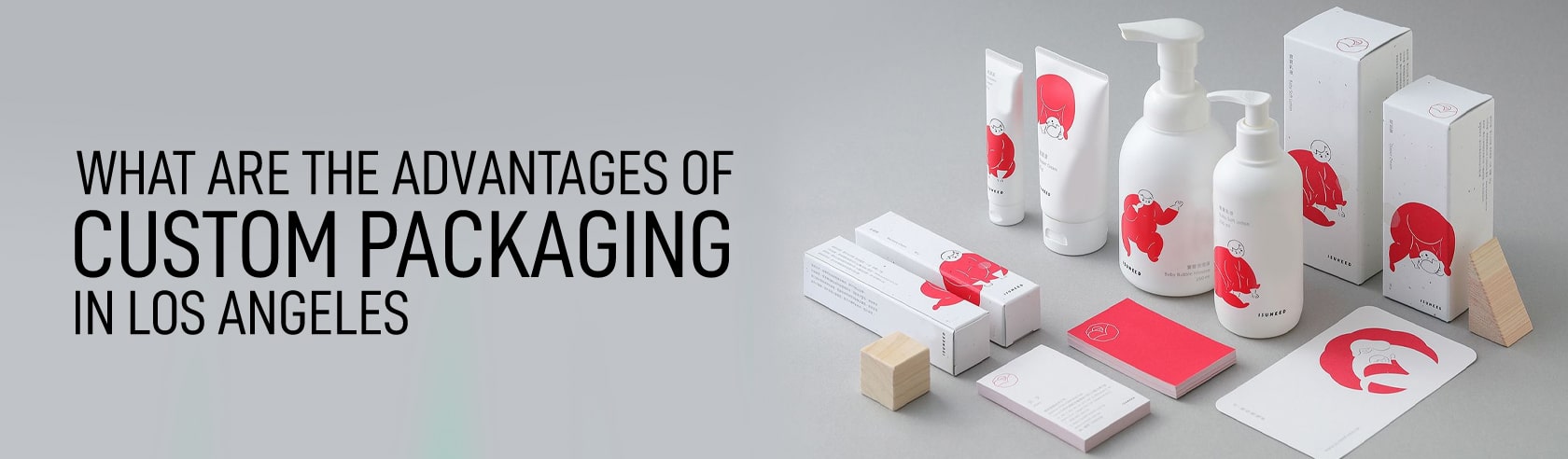
For Los Angeles beauty and entertainment brands, custom packaging is usually about unboxing performance: finish, insert fit and how the box photographs. Teal Packaging is a US manufacturer producing rigid magnetic boxes, cosmetic cartons and PR mailers with gold foil, spot UV, embossing and per-cavity foam seating. One order can carry up to 24 separate designs for multi-shade or multi-SKU launches. Free dieline design and free US shipping come with every order, with volume pricing from about $0.44 per unit at scale. Specialty rigid runs start at 100 units.
Questions or ready for a quote? Contact Teal Packaging at info@tealpackaging.com or (224) 546-8325.
The advantage of custom packaging is arithmetic, not atmosphere. A box built to the product cuts billable dimensional weight, removes most void fill, and drops damage claims. Shrinking a parcel from 12 x 10 x 8 in down to 9 x 7 x 3 in takes dimensional weight from roughly 7 lb to under 2 lb on a standard 139 divisor, on every order you ship.
Dimensional weight is where the money hides
Most domestic parcel contracts bill the greater of actual weight or cubic inches divided by a dimensional factor, commonly 139 at retail rates. Check your own carrier agreement for the divisor you are on, then run your real cartons through this math before deciding whether a custom size pays.
| Carton | Outside dimensions | Cubic inches | DIM weight at 139 | Void fill |
|---|---|---|---|---|
| Stock shipper, oversized | 12 x 10 x 8 in | 960 | 6.9 lb | Two handfuls of paper |
| Stock shipper, closer | 10 x 8 x 4 in | 320 | 2.3 lb | One handful |
| Custom mailer | 9 x 7 x 3 in | 189 | 1.4 lb | None |
| Custom mailer, small | 8 x 6 x 4 in | 192 | 1.4 lb | None |
| Custom cube | 6 x 6 x 4 in | 144 | 1.1 lb | None |
Void fill costs twice
Loose fill has a purchase price, a storage footprint in a Los Angeles warehouse where square footage is expensive, and a labor cost of several seconds per parcel at the pack bench. A right-sized box removes all three. It also removes the failure mode where a picker under-fills a large carton and the contents travel loose across four handling points. When product cannot move inside the box, corner crush stops mattering as much.
Regulated categories buy space, not just looks
Brands in CBD and similar categories are usually solving for panel area before anything else. Batch numbers, quantity statements, warnings, and a scannable code all need legible room, and 6pt type is the practical floor for reliable reproduction, with 8pt the floor for reverse type on dark solids. Two-piece constructions help: an outer carton carries the artwork while an inner sleeve or tray holds the unit. Child-resistant closures are a design feature of the structure, never a certified attribute, so if your buyer requires certification, that testing sits with a lab and not with a box supplier.
Tape and the rest of the pack-out
- Printed carton sealing tape comes in 2 in and 3 in widths; 3 in covers a wider seam and needs fewer passes.
- Polypropylene at about 2.0 mil handles light parcels; water-activated paper tape bonds into the fiber and resists a box cutter test better.
- One or two solid colors print cleanly on tape; photographic art does not.
- Tissue, stickers, and inserts are cheaper places to add color than a second print pass on the box itself.
Damage claims are a board problem
If parcels arrive crushed, the fix is usually flute and wall, not more filler. Single wall B-flute at 32 ECT handles most sub 20 lb parcels. Heavier or top-loaded freight moves to double wall BC at 48 ECT. E-flute at about 1/16 in is a print surface for retail-facing mailers rather than a strength grade, so a heavy product in an E-flute mailer will find the weak corner. Match board to weight first, then decide how pretty the outside needs to be.
Where a custom box does not pay
Custom stops earning when the product line changes size every quarter, when a single order will never repeat, or when the item already ships inside a mailer bag at under a pound. In those cases a stock carton plus a printed sticker and branded tape gets most of the visual benefit for none of the tooling. Custom starts winning when a size stabilizes, when a monthly shipping bill has a dimensional weight line you can attack, or when the box is part of what the customer is paying for. Run the parcel math on one month of real orders before deciding.
Artwork mistakes that cost a week
- Art supplied as a flattened JPEG with no bleed, which forces a redraw before plates can be made.
- Barcodes scaled below 80 percent magnification or printed on a dark panel, where scanners struggle.
- Rich black text on small type, which shows registration fringing at 6pt.
- Copy placed inside the glue tab area, where adhesive will cover it.
Quantities, tooling, and the per-unit curve
Custom work begins at 50 pieces, and specialty rigid constructions begin at 100. The die and plates are charged once and spread across whatever quantity you buy, so a per-unit figure only means something next to a quantity. Push the quantity high enough and quotes land close to $0.44 for each box. Ask any supplier for pricing at three quantities at once, for example 250, 1,000, and 5,000, so you can see the shape of the curve instead of one point on it.
Production routing and timing into Southern California
Two production sites carry the work, a floor in West Chicago, Illinois plus a plant in Guangzhou, with each order assigned by construction and volume. Domestic-lane orders can be ready in as little as seven business days from a signed proof, and specialty import work plans out at roughly twelve weeks. Hold both numbers loosely as scheduling windows. US shipping is included, which matters for bulky corrugated where freight can otherwise rival the boxes.
The quote packet that gets a real answer
Send inside dimensions, product weight, quantity tiers, board preference, finish list, artwork as vector files, and the carrier service you ship on. That last item lets a supplier sanity-check your size against dimensional weight before tooling. Dieline drawing is included at no cost and a digital proof is issued before production. If you want to compare structures first, the custom packaging pages list common formats by product type, and a $50 sample kit, credited to a first order, puts real board in your hands.

Ben Russell
Ben is a Senior Packaging Strategist and writer at Teal Packaging, covering packaging materials, design strategy, and practical branding insights.