
Key Takeaway
An eco-friendly packaging checklist for a small ecommerce brand runs ten steps: right-size the box, go mono-material, specify FSC-certified board, switch to water or soy based inks, drop plastic tape and fill, design for one recycling stream, print recycling guidance, audit supplier certifications, weigh freight impact, and re-check annually. Teal Packaging is a US manufacturer supporting each step with recyclable and FSC-certified options by specification and free dieline design on every order. Volume pricing starts from about $0.44 per unit at scale.
Questions or ready for a quote? Contact Teal Packaging at info@tealpackaging.com or (224) 546-8325.
The Eco-Friendly Packaging Checklist for Small Ecommerce Brands (10 Steps)
Eco-friendly packaging for a small ecommerce brand comes down to ten practical moves: right-size boxes to kill void fill, choose recycled or FSC-certified paperboard, use kraft or uncoated stocks where your branding allows, print with soy-based inks, design mono-material to avoid mixed plastic laminates, make the box curbside-recyclable and label it clearly, print care and recycling instructions on the box itself, consolidate SKUs around one adaptable dieline, order realistic quantities instead of chasing bulk pricing, and measure your packaging weight and DIM shipping class before and after each change. None of this requires exotic materials or a huge minimum order. A brand shipping a couple hundred orders a month can work through most of this list with a single box redesign, a low minimum order quantity, and honest language on the box: recyclable, recycled-content, or FSC-certified paper options, not vague sustainability claims that cannot be verified.
1. Right-Size the Box to Kill Void Fill
The biggest packaging waste driver for small ecommerce brands is shipping a product in a box that is too big and stuffing the gap with air pillows or crumpled paper. Void fill is dead weight: it adds material cost, it adds nothing to the customer experience, and it inflates your dimensional (DIM) shipping weight.
What to do: measure your product's actual footprint and order a box with 10 to 15 percent of headroom, not a generic size pulled off a shelf. If you sell one or two hero products, a custom-sized mailer box built to that footprint usually eliminates void fill entirely.
Spec example: a product measuring 8 x 6 x 2 inches should ship in a box close to 8.5 x 6.5 x 2.5 inches, not a generic 10 x 8 x 4 inch box that needs a fistful of packing paper to keep the contents from shifting.
2. Choose Recycled or FSC-Certified Paperboard
The paperboard itself carries most of a box's environmental footprint, so choosing recycled-content board or FSC-certified virgin fiber board is a bigger lever than any print effect you add later.
What to do: specify a recycled-content board, commonly 80 to 100 percent post-consumer fiber, for structural boxes, or select an FSC-certified paper option when virgin fiber is needed for strength or a coated finish. FSC certification means the fiber can be traced to a responsibly managed forest.
Spec example: a 24pt SBS (solid bleached sulfate) folding carton with an FSC-certified option, or an 18 to 24pt recycled kraft board for a shipping mailer. Check the paper weight chart to match board thickness to your product's weight and fragility. FSC-certified paper is available as an option on qualifying orders, not a default across every run, so specify it when you request a quote.
3. Prefer Kraft or Uncoated Stocks Where the Brand Allows
Coated and laminated boards look glossy on a shelf, but the plastic film laminate makes them harder to recycle, material recovery facilities have to separate the coating from the fiber before it can be pulped, and a lot of that material never gets separated.
What to do: if your brand identity does not require a high-gloss finish, default to uncoated kraft or a matte, uncoated board. It also reads as intentionally considered to customers without a single claim printed on the box.
Spec example: a 32 ECT (edge crush test) kraft corrugated mailer, or an 18pt uncoated kraft folding carton, instead of a gloss-laminated white carton. Browse kraft boxes for retail-ready formats that skip the laminate.
4. Use Soy-Based Inks
Standard petroleum-based inks release more volatile organic compounds during printing and are harder to strip from fiber during recycling than plant-based alternatives.
What to do: specify soy-based, or another vegetable-based, ink for offset or flexo print runs. It performs comparably to petroleum ink on color and coverage for most one to three color jobs.
Spec example: a one to two color soy-ink flexo print directly on kraft corrugated, or soy-based offset ink on an SBS carton. Mention soy ink in your quote request so the printer sets up the run with the right ink system from the start.
5. Design Mono-Material: Avoid Mixed Plastic Laminates
A box that mixes paper with a plastic window, foil lamination, or a plastic poly bag insert cannot be recycled as a single stream. Once a recovery facility sees film bonded to fiber, the easiest path is to reject the whole piece.
What to do: build the box, inserts, and tape from one material family, paper, wherever it is functionally possible. Skip die-cut plastic windows and plastic-film lamination.
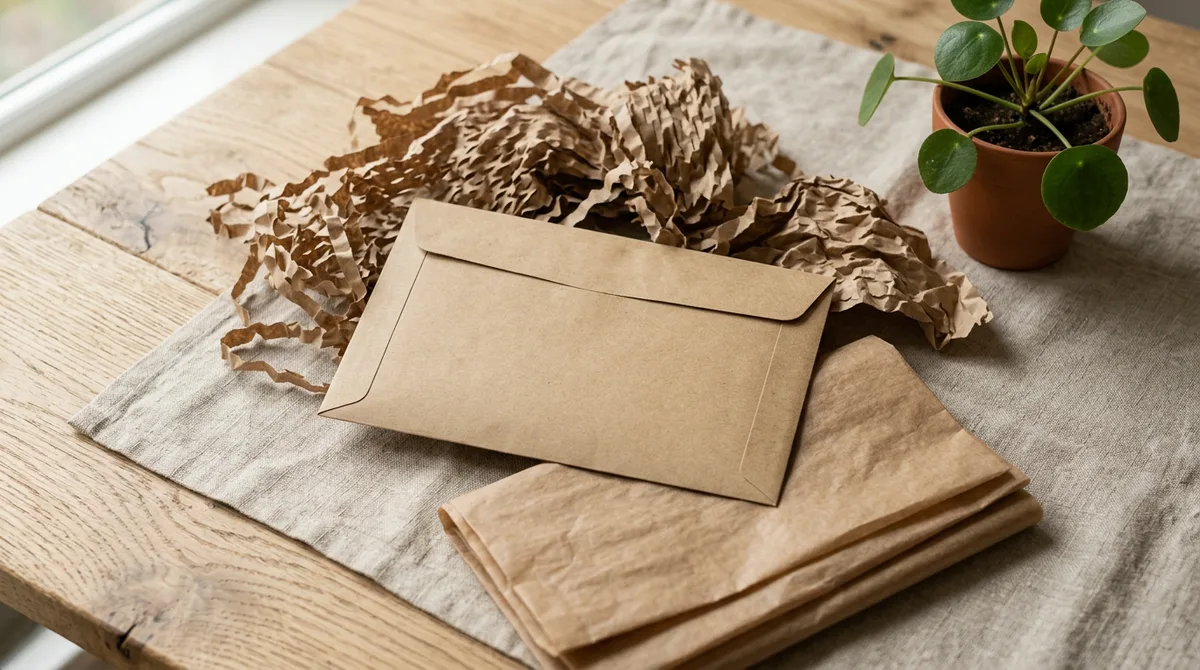
Spec example: paper honeycomb or crinkle-paper void fill and kraft paper tape instead of a PET display window and a plastic poly bag. If you need to show the product, a die-cut paper window or an open-face carton works without breaking mono-material design. See eco-friendly boxes for mono-material formats already built this way.
6. Make It Curbside-Recyclable, and Say So on the Box
A box that is technically recyclable does nothing for the waste stream if the customer does not know it, or worse, if they cannot tell and throw it away by default.
What to do: pick a format your local curbside programs actually accept, corrugated and uncoated or lightly coated paperboard both qualify almost everywhere, then print that fact on the box in plain language. Formats like bakery boxes and mailers already qualify without any adjustment.
Spec example: a single line printed on the interior flap or bottom panel: "This box is curbside recyclable. Please flatten before recycling." One ink color, no special plate required.
7. Print Care and Recycling Instructions
Beyond the recyclability statement, a short instructional block reduces contamination, the wrong material ending up in the wrong stream, which is one of the most common reasons recyclable material gets landfilled anyway.
What to do: dedicate a small printed area, an interior flap or an insert card, to material-specific disposal notes.
Spec example: a 2 x 3 inch single-color text block reading "Corrugated shipper: recyclable curbside. Tissue paper and inserts: check local guidelines before recycling." This is a design addition, not a new SKU, so it fits inside your existing dieline.
8. Consolidate SKUs Around One Adaptable Dieline
Every extra box size sitting in your warehouse is inventory that has to be forecast, stored, and eventually replaced when you update branding. Unused box stock is one of the most overlooked sources of packaging waste for small brands.
What to do: standardize on one dieline sized to your most common order footprint, and use insert or divider variations to handle smaller orders or multi-item shipments instead of a separate box for every SKU.
Spec example: replacing three or four box sizes with a single mailer dieline plus a slotted paper divider insert. Teal provides free dieline design, so consolidating sizes does not add a design cost on top of the material savings.
9. Order Realistic Quantities: Low MOQ Avoids Waste from Overordering
Chasing the lowest per-unit price by ordering a year of inventory in one run is a common way small brands end up with boxes sitting in storage, sometimes for a design that gets replaced before the stock runs out.
What to do: order what you will realistically use in 60 to 90 days, and work with a supplier whose minimum order quantity is low enough that a smaller, more frequent order does not carry a steep price penalty.
Spec example: Teal's standard minimum order is 50 units, 100 units and up for specialty rigid boxes, with unit pricing from $0.44 at volume, a free digital proof before the run prints, and free US shipping. Production typically begins around 7 business days after proof approval, longer for complex or high-volume runs. Ordering a sample kit first and requesting a quote sized to your actual sell-through, not a round number, keeps quantity honest from the start.
10. Measure Before and After: Materials by Weight, DIM Shipping Class
You cannot manage what you do not measure. The two numbers that actually reflect a packaging change are total material weight per shipment and DIM (dimensional) weight shipping class, since carriers bill on whichever is higher, actual weight or dimensional weight.
What to do: weigh your current box plus void fill and insert, and calculate the DIM weight using your carrier's divisor. Do the same after you make a change and compare both numbers side by side.
Spec example: a shipment that used a 14 oz corrugated shipper plus 2 oz of air pillow void fill, versus a right-sized 9 oz mailer with no void fill, drops both the material weight and, frequently, the DIM shipping class the carrier bills against.
Claims to Avoid on Your Packaging
It is tempting to print a broad sustainability claim on a box, but vague or unverifiable language carries real risk: environmental marketing claims face growing regulatory and legal scrutiny, and customers increasingly check before they trust a label.
Do not print "100% biodegradable" or "compostable" unless the material is certified to a recognized standard, such as ASTM D6400 for compostability, and you can produce that certification on request. Most standard corrugated and paperboard packaging is not certified compostable, even though the fiber itself will eventually break down in the right conditions. If you are evaluating those material categories for a future product line, our guides to biodegradable packaging and compostable packaging cover what actually qualifies before you commit to a claim.
Safer, defensible language: "recyclable," "made with recycled content," or "FSC-certified paper available." These are claims you can back up with a spec sheet, and they tell the customer exactly what to do with the box, which matters more for actual waste reduction than a broad claim ever will.
Frequently Asked Questions
Is recycled paperboard as strong as virgin fiber board?
For most retail and mailer boxes, yes, recycled-content board performs comparably at an equivalent thickness. For high-humidity or heavy-load applications, choosing the right point thickness or GSM matters more than whether the fiber is recycled or virgin, so match board weight to the product before you finalize a spec.
Do I need a certification to say my box is recyclable?
No. "Recyclable" is a factual claim about the material and format, corrugated and uncoated paperboard are accepted in most curbside programs, so you can state it directly as long as the format actually qualifies where your customers live. Certification is what you need for a claim like "compostable," not for basic recyclability.
What is the minimum order for eco-friendly custom boxes?
Standard custom boxes start at 50 units, and specialty rigid boxes start at 100 units. Pricing starts from $0.44 per unit at volume, with a free digital proof before production and free US shipping. Order a sample kit to see the board and print options in hand, then request a quote for your specific box and quantity.

Ben Russell
Ben is a Senior Packaging Strategist and writer at Teal Packaging, covering packaging materials, design strategy, and practical branding insights.