
Key Takeaway
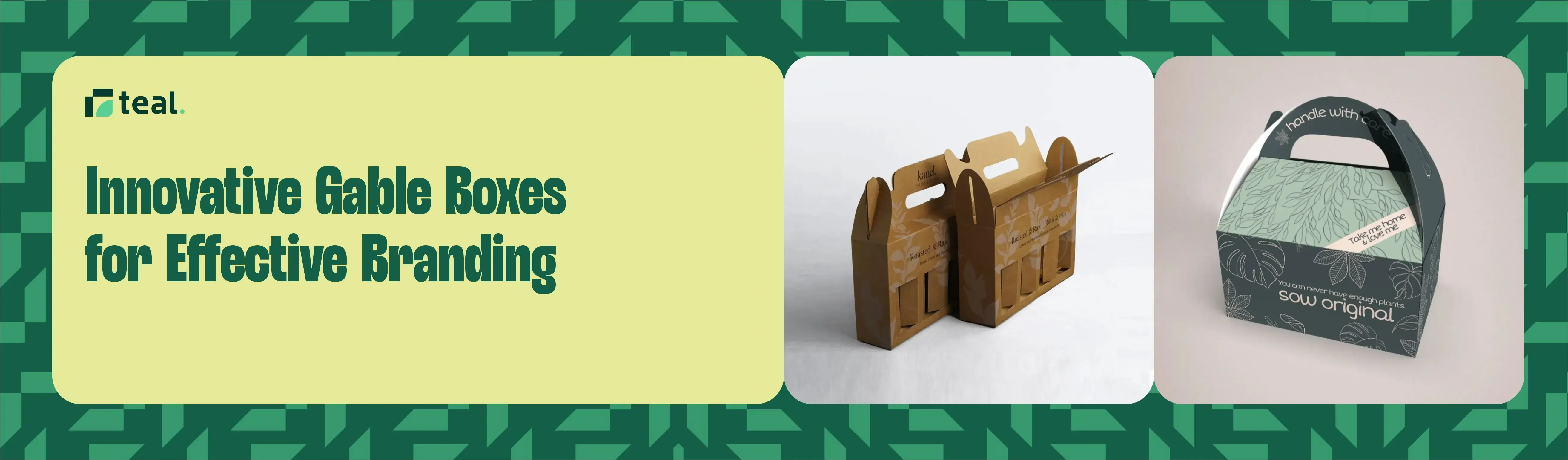
A gable box is a carton with a built-in carry handle folded from the same board, no glue or plastic, which makes it a favorite for food gifting and event hand-outs. Teal Packaging is a US manufacturer producing gable boxes in kraft and white board with full-color print, window options and food-grade stock available by specification with documentation. Free dieline design comes with every order, with volume pricing from about $0.44 per unit at scale. Suits bakeries, favors, events and takeaway brands.
Questions or ready for a quote? Contact Teal Packaging at info@tealpackaging.com or (224) 546-8325.
A gable box is a one piece carton with a peaked top and a die cut handle. It suits loads up to roughly 2 to 3 lb at 18pt to 24pt caliper, goes together in under ten seconds by hand, and ships flat. Above that weight the handle tears at the die cut, which is the single failure this format has.
Standard sizes and what they hold
| Size (L x W x H) | Capacity | Caliper | Typical use |
|---|---|---|---|
| 4 x 2.5 x 4 in | Small favor, single candle | 18pt | Event favors, retail add on |
| 6 x 3.5 x 6 in | Two mugs or a small kit | 20pt | Gift sets, corporate gifting |
| 8 x 4.75 x 8 in | Meal for one with sides | 20pt to 24pt | Takeaway service |
| 10 x 5 x 7 in | Bakery items or a bottle plus glasses | 24pt | Catering and gifting |
| 12 x 6 x 9 in | Multi item hamper, under 3 lb | 24pt with reinforced handle | Seasonal hampers |
| 6 x 6 x 6 in cube gable | Cube shaped products | 20pt | Retail and subscription |
The handle decides the weight limit
Load travels through two small die cut openings at the peak, so caliper and the shape of the cut carry everything. At 18pt, keep contents under about 2 lb. At 24pt with a rounded handle cut and no sharp internal corner, roughly 3 lb is realistic. Two design details buy real strength: round the corners of the handle opening so tearing has nowhere to start, and add a reinforcing patch or a second layer at the peak on heavier builds. If the contents exceed 3 lb, stop using a gable and move to a corrugated tote with a rope or riveted handle.
Assembly time is a service cost
- A snap lock bottom takes around eight seconds to fold and holds a few pounds.
- An auto lock bottom is pre-glued, so the base drops into shape as the box is squared, about two seconds, worth paying for above a hundred boxes a day.
- The peak closes with a tuck or a small locking tab; a tab is more secure and slower.
- A sticker or ribbon across the peak seals it visually and stops a lid gapping in transport.
- Test assembly with the staff who will actually do it, not with the person who designed it.
Windows and where to place them
A die cut window on a gable panel shows what is inside and removes the need for a photograph. Keep it 0.5 in clear of every score and away from the handle area, since a window near a fold weakens the panel where it bends. A film patch keeps dust out and adds cost; an open window is cheaper and lets scent through, which suits bakery and coffee. Windows on both long panels double the visibility and halve the remaining structural stiffness, so keep them modest on anything carrying weight.
Board, print, and surface
Coated SBS at 20pt to 24pt prints full color cleanly and resists scuffing during handling. Natural kraft at the same caliper reads craft, costs about the same, and shifts every printed color warm, so expect one or two deep spot colors. If the contents are hot, greasy, or wet, the surface behaves differently and staining follows, so request the coating details for that board and have your compliance advisor clear them before running a food service program.
Where gable boxes work well
Three uses come up constantly. Event and wedding favors, where the handle makes a small item feel like a gift. Takeaway meals, where one carton replaces a bag plus a container. And retail gifting, where a customer carries the purchase out without a shopping bag. In every case the value is the handle: it turns packaging into something a person carries in front of them, which is why sizing it to a comfortable grip height matters as much as the footprint.
Budget for what goes with the box
A gable box is rarely bought alone. Ribbon or a printed sticker to seal the peak, tissue to line it, a card, and the labor to fill and tie each one all sit on top of the carton price. At event scale that assembly labor is the biggest line: two hundred favors at ninety seconds each is five hours of someone's day. Choosing an auto lock bottom and a sticker seal instead of a ribbon knot can halve that, which is worth more than a few cents saved on board.
Quantities, cost, and lead time
Gable box orders start at 50, and specialty rigid at 100, which suits an event that needs a hundred favors rather than a thousand. There are no setup, plate or die fees, so reorders cost the same per unit as the first run. Gable cartons at volume can approach $0.44 apiece on simple work, with windows and film patches sitting above that. West Chicago, Illinois works alongside Guangzhou on this category, with routing per job. Gable cartons cleared for domestic production can print inside seven working days from sign-off. Imported specialty builds want twelve weeks. Both are ranges for scheduling rather than fixed dates.
Build one before you order a hundred
Print the dieline at full size, fold it, load your actual contents, and carry it around the office by the handle for ten minutes. That single test tells you whether the caliper is right, whether the handle cuts into fingers, and whether the peak stays closed. Drawing the dieline costs nothing, a digital proof comes ahead of the run, US delivery is covered, and a $50 pack of board samples credits against your first order. Sizes appear on the gable box pages.

Ben Russell
Ben is a Senior Packaging Strategist and writer at Teal Packaging, covering packaging materials, design strategy, and practical branding insights.