
Key Takeaway
Mylar bags suit supplements because the multi-layer foil laminate blocks oxygen, moisture and light, the three things that degrade capsules and powders. Stand-up pouches with resealable zippers keep daily-use products fresh after opening. Teal Packaging is a US manufacturer producing custom printed mylar bags with zipper, valve and window options at a low 50-unit minimum, with free design help and free US shipping. Volume pricing starts from about $0.44 per unit. Suits supplement, nutraceutical and wellness brands.
Questions or ready for a quote? Contact Teal Packaging at info@tealpackaging.com or (224) 546-8325.
Mylar bags suit supplement packaging because their multi-layer foil laminate blocks oxygen, moisture, and light, the three forces that degrade hygroscopic powders like protein, creatine, and greens. For most supplement brands, a resealable stand-up mylar pouch sized to the fill weight, printed full-color, protects potency and shelf appeal at low order minimums.
Supplements are unusually sensitive to their environment. Many powders pull water straight from the air (that is what "hygroscopic" means), which causes clumping, caking, and faster breakdown of active ingredients. Vitamins and botanical blends also fade or oxidize under light and oxygen exposure. A standard poly bag slows none of this well.
Mylar, the everyday name for a metallized or foil laminate film, layers PET, foil or a metallized layer, and a sealant into one structure. According to how these films are built, the foil ply is what delivers the near-total oxygen and moisture barrier that thin plastic cannot match. That is why capsule counts, single-serve stick packs, and bulk tubs of powder so often ship in mylar.
Why mylar for supplements
Mylar earns its place in supplement packaging through barrier performance. The foil laminate resists oxygen and water-vapor transmission far better than mono-layer plastic, which directly protects the moisture-sensitive powders and light-sensitive actives common in this category.
Three failure modes matter most for supplement brands, and mylar addresses each:
- Moisture: Protein, creatine, collagen, and greens powders absorb ambient humidity and clump. A foil barrier plus a good seal keeps them free-flowing.
- Oxygen: Oxidation degrades oils, probiotics, and many botanicals. Low oxygen transmission slows that decline, and an oxygen absorber can push it further.
- Light: An opaque foil laminate shields UV-sensitive vitamins that clear or amber plastic would let through.
For brands packing powders that need an added scavenger, our oxygen absorber calculator helps size the absorber to the bag's headspace. Note that biodegradability is not assumed for foil laminates; recyclable options exist by specification, so ask about material choices when you quote.
Bag styles for supplement products
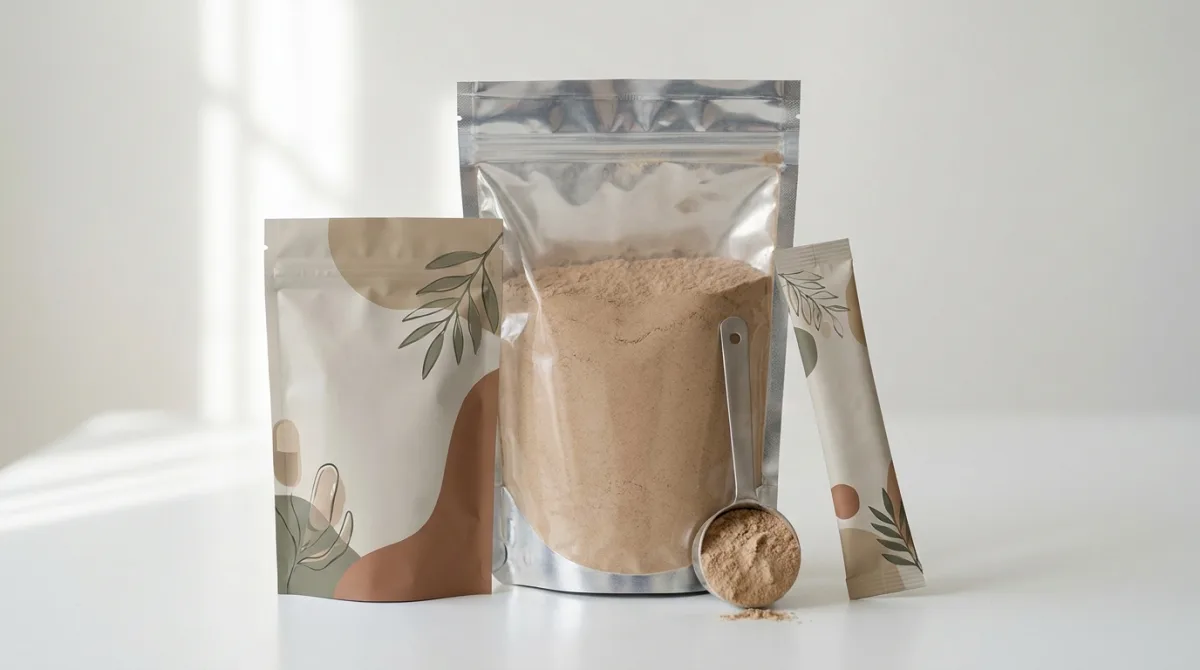
The right style depends on your product form and how the customer uses it. Stand-up pouches dominate powders and capsules for shelf presence and reseal; flat pouches fit single servings; side-gusset bags suit bulk.
| Bag style | Best for | Key feature |
|---|---|---|
| Stand-up pouch | Protein, greens, capsule counts, retail shelf | Stands unassisted, resealable zipper, large print face |
| Flat pouch | Single-serve powders, sample sachets, stick packs | Low material cost, compact, tear-notch friendly |
| Zipper pouch | Multi-serving tubs of powder | Reclosable for repeat use over weeks |
| Vacuum-seal bag | Bulk or wholesale powder, long storage | Removes air to slow oxidation |
Most supplement brands land on a resealable stand-up mylar pouch for retail SKUs. For bulk or long-storage lines, a custom mylar vacuum-seal bag reduces headspace air. Browse the full range on our custom mylar bags page.
Sizing mylar bags by fill weight
Size the bag to the powder's volume, not just its weight, because density varies widely between products. The same 2 lb (about 900 g) fill of protein, creatine, or greens can occupy noticeably different amounts of space, so confirm the usable bag volume against your own product's measured density and fill line rather than assuming a figure. Remember to leave headspace for a zipper and scoop.
Use these fill-weight ranges as a planning guide, then confirm against your exact density and fill line:
| Fill weight | Typical product | Common bag size range |
|---|---|---|
| 1 to 4 oz | Sample, single serving, capsule count | Small flat or stand-up pouch |
| 8 to 16 oz | Half-size powder, 30-serving tub | Mid stand-up pouch with zipper |
| 2 to 5 lb | Full protein or greens container | Large stand-up or side-gusset pouch |
Because scoop and headspace change the math, run your numbers through our mylar bag size finder before committing to a die. Getting the fill line right the first time avoids half-empty bags on shelf and wasted film.
Label and compliance considerations
Design your artwork so required information stays legible on a flexible, sometimes reflective surface. Supplement labeling generally needs a product identity, net quantity, ingredient and supplement facts, and manufacturer or distributor details, so plan panel space for all of it before you finalize the dieline.
Practical design tips
- Reserve a clean rectangle for the facts panel; foil backgrounds can hurt small-type contrast.
- Leave bleed and a safe zone around the zipper and seal so nothing critical gets trimmed or crimped.
- Confirm your own regulatory requirements with qualified counsel; compliance is the brand owner's responsibility, and we do not make regulatory claims on your behalf.
Teal includes free dieline design and two revision rounds with full-color print, so you can proof the facts panel and lock placement before production. Explore print options on our custom printed mylar bags page.
MOQ, pricing, and turnaround
Teal runs custom mylar bags from a 50-unit minimum order, with pricing from $0.44 per unit on bulk orders and every job quoted to your exact spec. That low MOQ lets newer supplement brands test a SKU without committing to a full pallet.
What is included and what to expect:
- MOQ: From 50 units standard (specialty rigid formats start at 100+).
- Pricing: From $0.44/unit on bulk, quoted to spec, with free dieline design and free US shipping.
- Materials: Multi-layer mylar and foil laminate; recyclable options by specification.
- Turnaround: Production from about 7 business days after proof approval (complex or high-volume runs take longer), plus 2 to 5 business days for US delivery from our West Chicago, IL fulfillment.
Want to feel the film before you buy? Order a $50 sample kit (credited to your first order) to check finish and thickness in hand. For food-adjacent storage formats, see our custom mylar food storage bags.
Frequently Asked Questions
Are mylar bags good for protein powder?
Yes. Protein powder is hygroscopic and clumps when it absorbs moisture, so the foil laminate's moisture and oxygen barrier helps keep it free-flowing and fresh. A resealable stand-up pouch is the most common format for retail protein SKUs.
What size mylar bag do I need for supplements?
Size by volume, not weight alone, since powder density varies. The same weight of protein, creatine, or greens can occupy different volumes, so measure your own product's density and add headspace for the zipper and scoop. Run your exact numbers through the mylar bag size finder before ordering a die.
Do mylar supplement bags need an oxygen absorber?
Not always, but oxygen-sensitive powders (oils, probiotics, some botanicals) benefit from one. Match the absorber to the bag's headspace; our oxygen absorber calculator helps size it correctly.
What is the minimum order for custom mylar supplement bags?
Teal's standard minimum is 50 units, with specialty rigid formats starting at 100+. Pricing runs from $0.44 per unit on bulk orders, quoted to your exact spec, and includes free dieline design and free US shipping.
How long do custom mylar supplement bags take to produce?
Production runs from about 7 business days after proof approval, with complex or high-volume runs taking longer, plus 2 to 5 business days for US delivery from our West Chicago, IL fulfillment.
Ready to spec your supplement pouch? Request a quote and we will size the bag to your fill, quote to your exact spec, and get a proof in your hands before production.

Ben Russell
Ben is a Senior Packaging Strategist and writer at Teal Packaging, covering packaging materials, design strategy, and practical branding insights.