
Key Takeaway
Bakery packaging is chosen by the product's fragility and moisture: sturdy corrugated or thick paperboard for cakes, windowed cartons for cookies and pastries, and grease-resistant board available by specification with documentation for oily bakes. Teal Packaging is a US manufacturer producing cake boxes, windowed bakery cartons and printed bags with free dieline design on every order. Volume pricing starts from about $0.44 per unit at scale. Suits bakeries, patisseries and cottage-food brands moving from stock white boxes to branded packaging.
Questions or ready for a quote? Contact Teal Packaging at info@tealpackaging.com or (224) 546-8325.
The short answer
Match the packaging to the product, not the other way around. Sturdy corrugated or thick cardboard boxes protect cakes and gift orders, printed bags and window boxes move cookies and pastries at the counter, and grease-resistant coatings keep butter from staining either one. With custom minimums starting at 50 units, small bakeries no longer have to buy plain stock in bulk.
Teal Packaging (tealpackaging.com) is a US-based custom packaging supplier that makes custom bakery boxes and printed bakery bags from a 50-unit minimum order quantity. Bakery orders include full-color printing, free dieline design, and free US shipping, with standard production from about 7 business days after proof approval (complex or high-volume orders take longer) and volume pricing from $0.44 per unit. Window cutouts, grease-resistant coatings, and FSC-certified or recyclable paper options are available by specification. The range suits cookie shops, cake studios, patisseries, and home bakers moving into wholesale.
Start with what you're packing
Bakery products are hard on packaging in ways most retail goods aren't. They're greasy, they're fragile, and some of them are still warm when they go in the box. Before you look at a single design option, write down three things about your bestseller: how much oil or butter it gives off, how easily it crushes, and whether it needs to travel or just make it from the counter to a customer's car.
Those three answers decide most of the buying choices below. A dense biscotti can ride in a thin paper bag. A cream-topped cupcake needs a rigid structure, an insert to stop it sliding, and enough headroom that the lid never touches the frosting. A two-tier cake needs a corrugated box that can take weight on its corners and a hand underneath it.
Boxes or bags?
Most bakeries end up ordering both, in different roles. Boxes carry the fragile, high-margin items and anything sold as a gift. Bags handle speed at the counter. Here's how the common products map out:
| What you sell | Best format | Why it works |
|---|---|---|
| Cookies, biscotti, rusks | Printed bags or small window boxes | Fast to pack, cheap per unit, and a window sells the product for you |
| Cupcakes and muffins | Boxes with inserts | The insert stops sliding; the box protects the frosting |
| Whole cakes | Corrugated cake boxes | Corrugated board carries the weight without bowing |
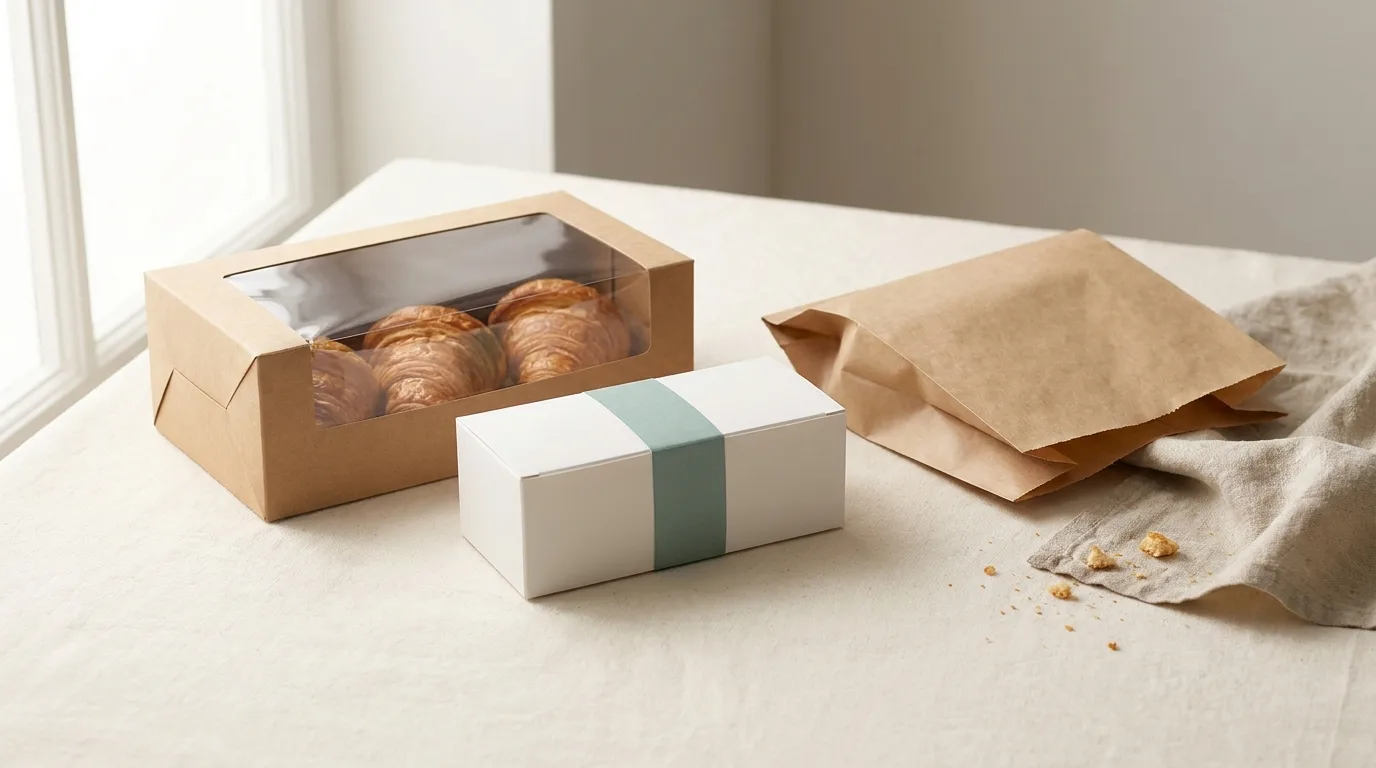
| Croissants and pastries | Window folding cartons | Grab-and-go format that still looks like a considered brand |
| Bread loaves | Paper bags, printed or plain | Breathable paper keeps crusts crisp where film would soften them |
| Gift assortments | Rigid or heavyweight gift boxes | The unboxing moment justifies the higher unit cost |
If bags are the bigger part of your day, it's worth pricing custom bakery bags as their own line item rather than an afterthought to the box order. Printed bags typically cost less per unit than boxes, so they put your brand in every customer's hand without much added spend.
When a window earns its place
A window cutout adds a little cost and one more decision (film or open), but for counter sales it usually pays for itself. Customers buy what they can see, and staff spend less time opening boxes to show what's inside. Skip the window for anything that travels long distances in summer heat; a solid panel simply protects better on the road.
Materials that stand up to grease and moisture
Bakery packaging fails in predictable ways: grease shadows on the board, soggy bottoms, and lids that collapse when boxes are stacked. The fixes are material choices, not design choices.
Kraft paperboard in the 300 to 400 gsm range is the workhorse for cookie and pastry boxes. It takes print well, folds cleanly, and has a natural look that suits bakery brands. White SBS board (14 to 18 pt) gives you a brighter print surface for pastel or photo-heavy designs. For cakes and anything stacked or shipped, corrugated board with an E or B flute adds crush resistance without much weight.
Two options worth asking about on any bakery order: a grease-resistant coating, which keeps butter and oil from wicking into the board and staining the print, and FSC-certified or recyclable paper, available by specification if sustainability is part of your brand story. Inks matter too; soy and water-based inks are the standard for this kind of work.
Measure before you order
Order the box for the product you actually sell, not a "close enough" stock size. Undersized boxes crush frosting and corners. Oversized boxes let product slide, which does more damage in transit than most people expect. Measure your largest regular item, add clearance for frosting or toppings, and let that number drive the dieline. If you're moving into wholesale bakery packaging, get the retailer's shelf dimensions first; a box that's an inch too tall for the display shelf is a box you'll reorder.
This is also where a custom supplier earns its keep over stock packaging. Dieline design is included free on Teal orders, with two revision rounds, so you can fix a sizing mistake on paper instead of on 500 printed boxes.
Minimums, pricing, and turnaround
The economics of custom bakery packaging changed when minimums came down. Teal's standard custom projects start from 50 units, which means a weekend market stall can carry printed boxes, not just an established shop. Every job is quoted to spec, and volume pricing starts from $0.44 per unit on bulk orders.
On timing, plan for production from about 7 business days after you approve the proof (complex or high-volume orders take longer), plus 2 to 5 business days for US delivery. Express and economy options exist on both ends. If you want to check print quality and board feel before committing, a generic sample kit is available for $50, credited toward your first custom order. You can request one from the sample kit page.
FAQ
What is the minimum order for custom bakery boxes?
Standard custom projects at Teal Packaging start from 50 units. Specialty rigid boxes, the kind used for premium gift assortments, start from 100 units.
How much do custom bakery boxes cost?
Every job is quoted to its specification, since size, board, coating, and print coverage all move the number. As a reference point, volume pricing starts from $0.44 per unit on bulk orders, and quotes include free dieline design and free US shipping.
How long does production take?
Standard production runs from about 7 business days after proof approval, with complex or high-volume orders taking longer. Add 2 to 5 business days for US delivery, with express and economy options available.
Can I get bakery boxes with a window?
Yes. Window cutouts are a standard option on bakery boxes, and they work well for counter sales where customers choose with their eyes. They're less suited to long transit in warm weather.
Are eco-friendly bakery boxes available?
FSC-certified paper and recyclable options are available by specification, and soy and water-based inks are standard. If you want the full breakdown, ask for the eco options when you request your quote.
Get bakery packaging quoted to your spec
The fastest way to price a bakery box or bag is to send the product dimensions and a rough quantity through the quote form. Dieline design and two revision rounds are included free, so you don't need finished artwork to start. Prefer to talk it through? Call (224) 546-8325 or email info@tealpackaging.com and describe what you're packing; that's genuinely the whole brief.

Ben Russell
Ben is a Senior Packaging Strategist and writer at Teal Packaging, covering packaging materials, design strategy, and practical branding insights.