
Key Takeaway
Low-minimum custom packaging exists so a brand can print a first run without committing to thousands of units: at Teal Packaging, a US manufacturer, standard custom projects start at 50 units and specialty rigid at 100. Free dieline design, 2 revision rounds and free US shipping come with every order, and dielines stay on file so a successful test scales into volume pricing from about $0.44 per unit. Suits founders validating packaging before a launch, and brands running small-batch or seasonal lines.
Questions or ready for a quote? Contact Teal Packaging at info@tealpackaging.com or (224) 546-8325.
Quick answer: You do not need to order thousands of boxes to get custom printed packaging. Teal Packaging offers low-minimum custom runs starting at a 50-unit minimum order (100 or more for specialty rigid boxes), so small brands, launches, and limited editions can get real custom boxes without committing to a huge run. Small runs cost more per unit than bulk, but the entry point is a manageable 50 units, not a warehouse-filling order.
One of the biggest myths in custom packaging is that you have to buy in the thousands. That was closer to true a decade ago. Today, low-minimum custom packaging lets a new brand order a real, printed, on-brand box in small quantities. Here is how low minimums actually work, and how to order a small run without overpaying.
What is the minimum order for custom packaging?
At Teal, custom printed packaging starts at a 50-unit minimum order, with specialty rigid boxes starting at 100 units. That is the low-minimum entry point: enough units to justify the dieline, proof, and setup, but small enough that a launch, a test batch, or a limited edition does not require a bulk commitment. To be clear, this is a low minimum, not the absence of one. Custom printed packaging is made to your spec, so there is always a run size that makes the setup worthwhile.
Why do custom boxes have a minimum at all?
Because every custom run needs a dieline, a proof and press make-ready time before the first box comes off the line, whether you print 50 boxes or 50,000. Teal does not charge setup, plate or tooling fees for any of that, but 50 units is the smallest run that keeps the per-unit price sensible (100 or more for specialty rigid). If a vendor promises fully custom printed packaging with no order requirement at all, that setup work is usually being paid for through a very high per-unit price. A stated low minimum is the more honest structure.
Who is low-minimum packaging for?
Small runs fit the moments when you cannot or should not commit to bulk:
- New brands validating a product before scaling.
- Product launches that need on-brand boxes but not a full warehouse of them.
- Limited editions and seasonal drops with a deliberately capped quantity.
- Sample and PR sends where you need a modest number of premium boxes.
- Testing designs before locking in a larger production run.
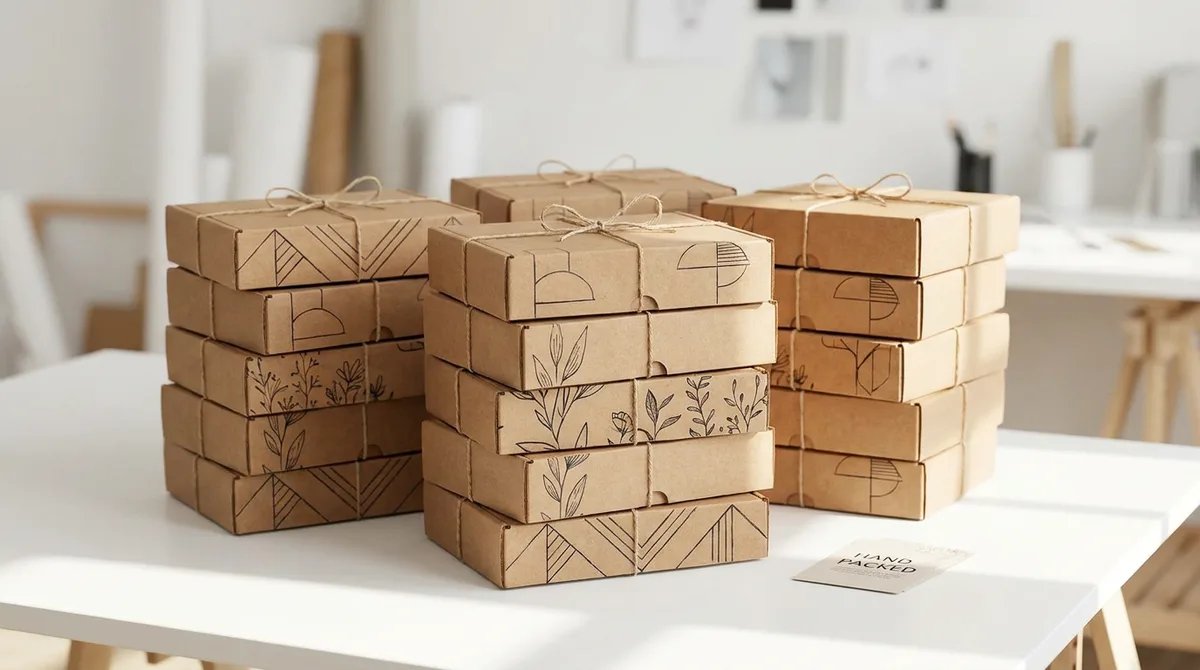
For all of these, a low-minimum custom box like a custom mailer box gets you a real branded package without the cash and storage burden of a bulk order.
What does a small run cost compared to bulk?
More per unit, and that is the honest tradeoff. A 50-unit run has a higher per-unit price than a 5,000-unit run because the same dieline, proof and make-ready work goes into far fewer boxes. As a rough guide only, small runs sit at the higher end of the pricing curve and bulk runs reach from about $0.44 per unit at higher volumes. You are paying a premium per box for the flexibility of a small commitment, which is usually worth it when you are testing or launching. For a real number at your quantity, use the request a quote form.
How do you keep a small run affordable?
A few choices soften the per-unit premium on a low-minimum order:
- Pick a standard size that prints and ships efficiently.
- Keep print colors reasonable, since each color adds setup.
- Choose corrugated or kraft over specialty rigid when the product allows, for a lower entry point.
- Use the free dieline design Teal includes, so you are not paying a separate layout fee.
- Order the quantity you will actually use before your next design change.
These keep quality high while holding the small-run price down, and they set you up to reorder at a lower per-unit price as you grow.
Can you scale up later from a small run?
Yes, and that is the point of starting small. Once your design is proven, the same dieline and artwork move straight into a larger run at a lower per-unit price. Many brands start at or near the 50-unit minimum to test a box, then reorder in larger batches as demand grows. Because Teal keeps your specs and dieline on file, scaling up is a reorder, not a restart. If you later need those boxes packed and shipped to customers, that is handled through fulfillment, quoted separately.
What do you need to order a small run?
Very little to start. Share the product the box needs to hold or a rough size, any material or print preference, and your target quantity at or above the 50-unit minimum. If you only have artwork, that is enough: Teal builds the dieline for free and proofs the box before it runs. Production runs from about 7 business days after proof approval, with complex or high-volume runs longer.
How is a low-minimum custom run different from stock boxes?
Stock boxes and low-minimum custom runs solve different problems. A plain stock box is pre-made in a standard size with no printing, so you can often buy a small quantity instantly, but you get no branding and limited size options. A low-minimum custom run is your own box: your size, your material, and your print, made to order from 50 units. The tradeoff is straightforward. Stock is cheaper and faster for a generic box; custom gives you a branded package that looks like your brand made it on purpose.
For many small brands the answer is a low-minimum custom run rather than stock, because the unboxing is part of the product experience. A branded box at 50 units still costs more per unit than bulk, but it turns a shipment into a brand moment in a way a blank box cannot. If you genuinely need only a handful of unbranded boxes, stock is fine. If you want your name on the box, a small custom run is the honest entry point.
The same logic applies as you grow: your first small custom run proves the design, and every reorder rides the volume curve toward a lower per-unit price. Starting at the low minimum is not a compromise, it is the sensible first step of a plan that scales.
How do you get started with a low-minimum order?
Decide your quantity (from 50 units, or 100 for specialty rigid), then get a real price for it. Browse styles in the shop and send your specs through the request a quote form. You will get a per-unit and delivered number for your small run, with free dieline design and free US shipping on custom orders, so you can launch on-brand without a bulk commitment.

Ben Russell
Ben is a Senior Packaging Strategist and writer at Teal Packaging, covering packaging materials, design strategy, and practical branding insights.