
Key Takeaway
For shelf-stable food, coffee and supplements, mylar's multi-layer foil laminate gives the strongest oxygen, moisture and light barrier; plain foil bags trade durability for cost, and poly bags suit short-shelf-life or non-sensitive products where clarity matters. Teal Packaging is a US manufacturer printing all three formats at a 50-unit minimum with free design help and free US shipping. Volume pricing starts from about $0.44 per unit at scale. Suits brands matching barrier level to product shelf life.
Questions or ready for a quote? Contact Teal Packaging at info@tealpackaging.com or (224) 546-8325.
For most shelf-stable food, coffee, and supplement products, mylar (a multi-layer foil laminate) gives the strongest barrier: it blocks light, oxygen, and moisture while staying printable and durable. Plain foil blocks well but tears and creases easily. Poly bags are the cheapest and clearest, but they let in oxygen and light, so they suit fast-moving, short-shelf-life items.
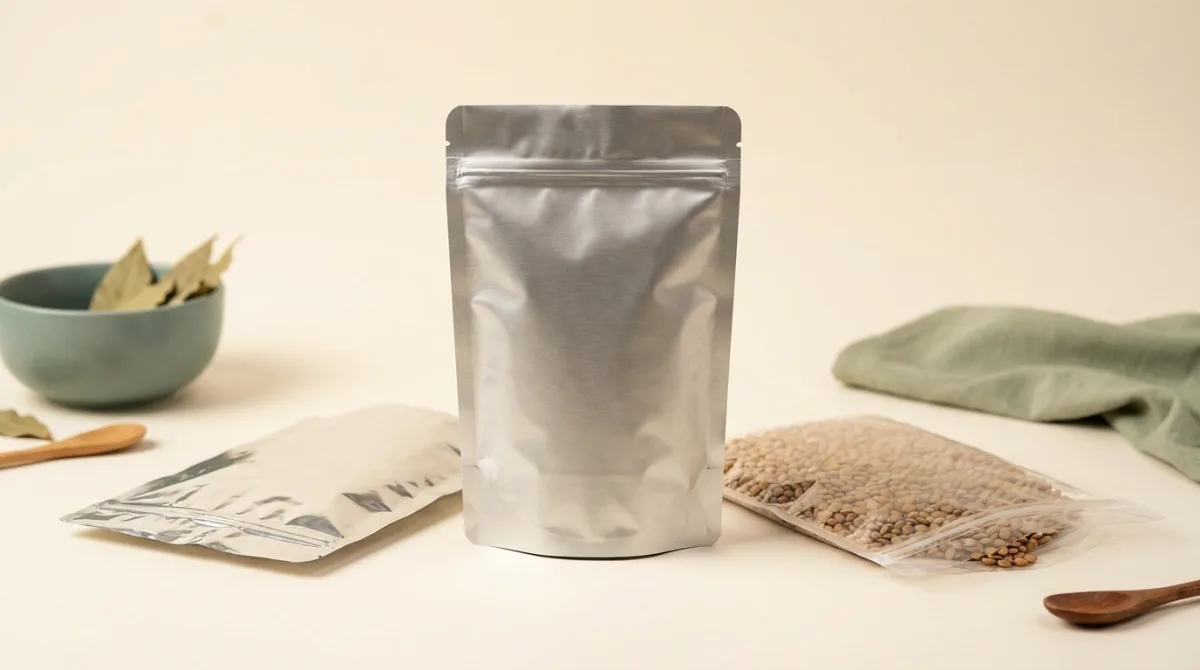
The three names get used loosely, so it helps to define them. "Mylar" in packaging almost always means a laminate stack (a polyester outer, an aluminum foil or metalized layer in the middle, and a food-contact inner film like polyethylene). That sandwich is why it resists punctures and blocks light and gas at once.
"Plain foil" refers to a thin aluminum layer with little or no reinforcing film. It's an excellent barrier by itself, but aluminum is brittle, so unsupported foil pinholes and cracks under flexing. "Poly bags" are single-layer plastic (usually polyethylene or polypropylene). They're flexible, often clear, and inexpensive, but a single polymer layer is a weak gas and light barrier.
Mylar vs Foil vs Poly Bags: Comparison Table
The table below sums up how the three materials compare on the factors that decide most packaging choices. Use it as a quick screen, then confirm the exact structure against your product's shelf-life target.
| Factor | Mylar (foil laminate) | Plain foil | Poly bags |
|---|---|---|---|
| Overall barrier | Very high (multi-layer) | High but fragile | Low to moderate |
| Light block | Full (opaque metal layer) | Full | None (clear) to partial |
| Oxygen block | Very high | High | Low |
| Moisture block | Very high | High | Low to moderate |
| Durability | High (puncture-resistant) | Low (cracks, pinholes) | Moderate |
| Printability | Excellent, full-color | Limited | Good |
| Relative cost | Mid to higher | Mid | Lowest |
| Best use | Long shelf life, oxygen-sensitive goods | Single-use, formed seals | Short shelf life, visible product |
How Each Material Handles the Three Threats
Light, oxygen, and moisture are the three forces that stale, oxidize, and clump most dry goods. Each material handles them differently.
Light
Light degrades oils, vitamins, and pigments. The aluminum layer in mylar and foil is opaque, so both block light fully. Clear poly bags block none, which is why light-sensitive products in poly often add a printed or pigmented film.
Oxygen and moisture
Oxygen drives rancidity and flavor loss; moisture drives clumping and mold. A metal or metalized layer is a near-total gas and vapor barrier, so mylar and foil far outperform single-layer poly. For oxygen-sensitive goods packed in mylar, brands often add an oxygen absorber sized to the headspace. Our oxygen absorber calculator helps you match the absorber to your bag volume.
Cost and Printability Tradeoffs
Poly is the lowest-cost option per unit and prints well, which is why it dominates produce, apparel, and mailers. Mylar sits mid to higher because you're paying for multiple laminated layers, but it also takes crisp full-color print and holds structure on a shelf. Plain unsupported foil is rarely used for printed retail pouches because its surface is harder to print and it damages easily in handling.
If retail shelf presence matters, mylar usually wins on balance: strong barrier plus a printable surface for branding. Our custom printed mylar bags and stand-up mylar pouches pair full-color print with the multi-layer barrier, and every order includes free dieline design and two revision rounds.
How to Choose for Your Product
Start with shelf life and sensitivity, then work backward to the material. Long shelf life or oxygen-sensitive contents point to mylar; short shelf life with visual appeal points to poly.
- Coffee, nuts, dried fruit, jerky: mylar for the oxygen and moisture barrier. See custom mylar food storage bags.
- Long-term dry storage (grains, dehydrated meals): heavier-gauge mylar, often with a vacuum seal. See custom mylar vacuum seal bags.
- Supplements, powders, herbal or specialty brands: mylar for barrier plus printable branding.
- Fast-moving retail, visible product, mailers: poly for cost and clarity.
Not sure what gauge or dimensions you need? Our mylar bag size finder narrows it down, and the full custom mylar bags range covers standard and specialty formats.
What Teal Offers
Teal is a US-based packaging supplier with fulfillment in West Chicago, IL. Custom mylar orders start from a 50-unit MOQ (specialty rigid formats from 100+), with pricing from $0.44 per unit on bulk orders and quoted to your exact spec. You get free dieline design, free US shipping, two revision rounds, and full-color print. Production runs from about 7 business days after proof approval (complex or high-volume runs take longer), plus 2 to 5 business days for US delivery. Recyclable material options are available by specification. To see and feel the laminate before you commit, order a $50 sample kit (credited to your first order).
Frequently Asked Questions
Is mylar the same as foil?
Not exactly. In packaging, "mylar" usually means a multi-layer laminate that includes a polyester film, an aluminum foil or metalized layer, and a food-contact inner film. Plain foil is just the aluminum layer, which barriers well but cracks and pinholes without a supporting film.
Which blocks oxygen best, mylar or poly?
Mylar. Its metal or metalized layer is a near-total oxygen barrier, while single-layer poly bags let oxygen pass relatively freely. For oxygen-sensitive products, brands typically choose mylar and add an oxygen absorber sized to the headspace.
Are poly bags ever the better choice?
Yes. When a product moves fast, has a short shelf life, or benefits from being visible on the shelf, poly bags are the lower-cost, clearer option. They just aren't the right pick for long shelf life or oxygen-sensitive contents.
Do mylar bags need an oxygen absorber?
For long-term storage of oxygen-sensitive goods, an absorber helps remove residual oxygen in the headspace after sealing. Match the absorber size to your bag volume; our oxygen absorber calculator does the math for you.
Are mylar bags food-safe and recyclable?
Food-contact suitability and recyclability depend on the specific structure you order, so we confirm both by specification rather than assuming them. Recyclable material options are available on request, and we'll document what each layer is rated for.
What's the minimum order for custom mylar bags?
Custom mylar orders start from a 50-unit MOQ, with specialty rigid formats from 100 units. Pricing starts from $0.44 per unit on bulk orders and is quoted to your exact spec.
Ready to match the right barrier to your product? Request a quote and we'll spec the material, gauge, and print to your shelf-life target, with free dieline design included.

Ben Russell
Ben is a Senior Packaging Strategist and writer at Teal Packaging, covering packaging materials, design strategy, and practical branding insights.