
Key Takeaway
ShipBob and ShipMonk are general 3PLs: they store inventory and ship orders, but your custom packaging still comes from a separate manufacturer and travels a freight leg to reach them. Packaging-manufacturer fulfillment collapses that chain: Teal Packaging prints the boxes and runs kitting and ship-to-recipient from the same West Chicago, Illinois operation. That suits branded kits, subscriptions and gifting where the box is custom. Runs start at 50 units with volume pricing from about $0.44 per unit at scale, with free dieline design.
Questions or ready for a quote? Contact Teal Packaging at info@tealpackaging.com or (224) 546-8325.
Quick answer: ShipBob and ShipMonk are established third-party logistics (3PL) providers: they store your inventory and pick, pack, and ship your orders from their fulfillment centers, but they do not manufacture your packaging. You bring your own boxes. An all-in-one packaging brand like Teal is a custom printed packaging manufacturer that also kits and ships, so the same company makes your box and fulfills the order from its West Chicago, Illinois center. The right choice depends on whether custom packaging is central to your brand.
This is a fair comparison of structural models, not a scorecard of one company beating another. ShipBob and ShipMonk are strong at what 3PLs do. The question is whether your brand needs a logistics network, a packaging manufacturer that also fulfills, or both.
ShipBob vs ShipMonk vs an all-in-one packaging brand: what is the real difference?
The clearest way to see it: ShipBob and ShipMonk start from logistics and treat packaging as something you supply. A packaging-led brand starts from manufacturing your box and adds fulfillment on top. Same destination (your customer's doorstep), different starting points, and that starting point determines what each is best at.
What are ShipBob and ShipMonk?
ShipBob and ShipMonk are both well-known 3PLs that serve ecommerce brands. They provide warehousing, pick-pack, and shipping across multiple fulfillment centers, along with order-management software and integrations to common ecommerce platforms. Both are built to absorb volume and to route orders efficiently, and both can handle kitting for the inventory you send them. What they are not is packaging manufacturers: the custom printed box that carries your brand is something you source elsewhere and ship to them to store as another SKU. That is not a criticism, it is simply their model.
Where do the three differ structurally?
| Capability | ShipBob (3PL) | ShipMonk (3PL) | Teal (packaging plus fulfillment) |
|---|---|---|---|
| Core business | Ecommerce fulfillment | Ecommerce fulfillment | Custom packaging manufacturer that also fulfills |
| Prints your custom packaging | No, you supply it | No, you supply it | Yes, prints your boxes |
| Warehousing and storage | Yes | Yes | Yes |
| Pick-pack and ship | Yes | Yes | Yes |
| Kitting and assembly | Yes | Yes | Yes, around packaging it printed |
| Fulfillment footprint | Multiple fulfillment centers | Multiple fulfillment centers | West Chicago, Illinois center |
| One vendor for box and fulfillment | No, packaging sourced separately | No, packaging sourced separately | Yes, under one quote |
| Best fit | High-volume, multi-node ecommerce | High-volume ecommerce and subscriptions | Packaging-led brands wanting box, kit, and ship together |
What does a 3PL do well?
A dedicated 3PL is purpose-built for logistics at scale. If you ship high volume, want inventory spread across multiple regions to cut transit time, need deep ecommerce-platform integrations, or sell generic or supplier-provided packaging, a 3PL is often the right tool. Their networks and software are designed for exactly that, and a packaging-first brand is not trying to replace a national logistics network.
What does a packaging manufacturer that also fulfills do well?
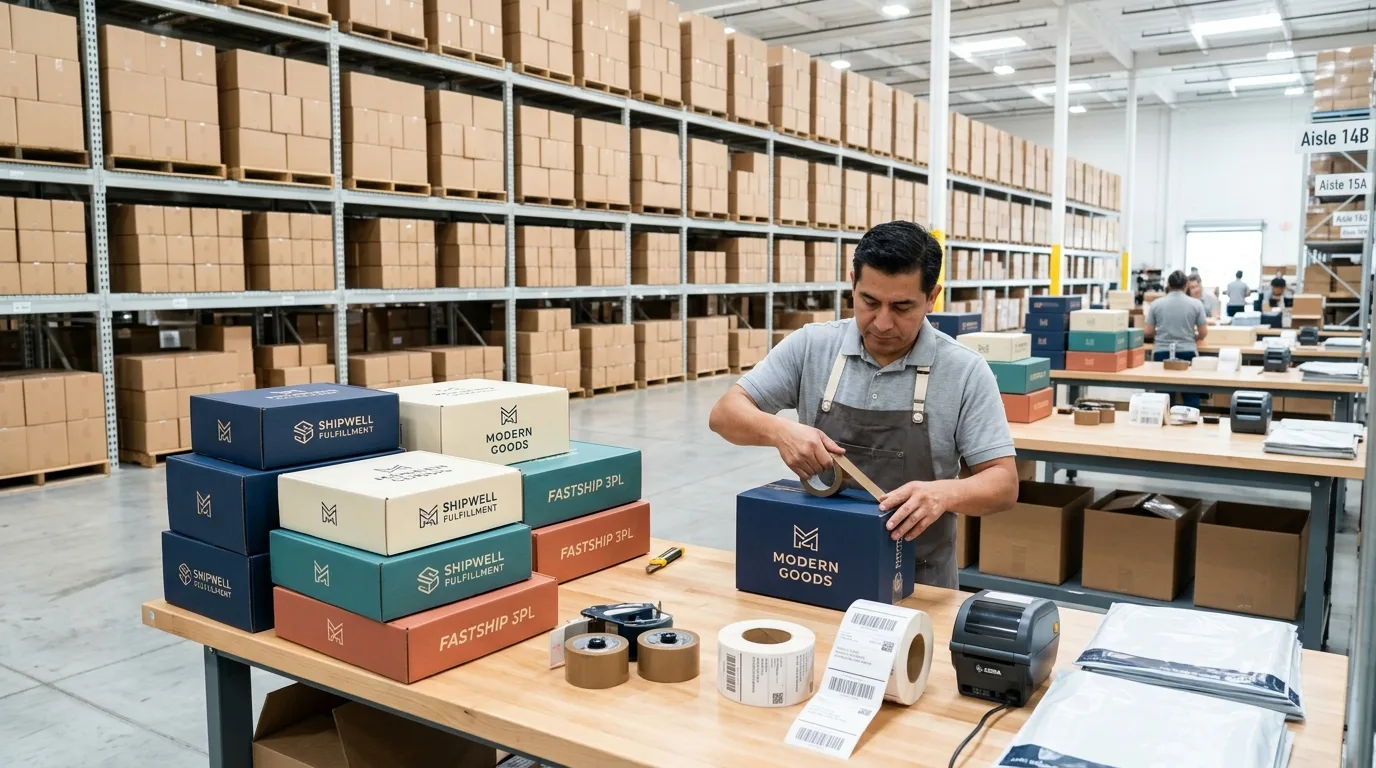
The all-in-one packaging model shines when the box itself is part of the product. Teal prints your custom packaging and then kits, packs, and ships it from its West Chicago fulfillment center, so you are not managing a packaging manufacturer and a 3PL as two vendors with two invoices and an inbound-freight step between them. The company that made your box owns its counts, its quality, and its pick, pack, and ship. For brands whose unboxing is the differentiator, that single-vendor seam removes a handoff. See how Teal frames the combined offer on its fulfillment page.
Which should you choose?
- Choose a 3PL when logistics scale, multi-region inventory, and platform integrations matter most and your packaging is standard or sourced separately.
- Choose a packaging-plus-fulfillment brand when custom printed packaging is core to your brand and you want one company to make it, kit it, and ship it.
- Consider both if you are large enough to split the roles deliberately.
Can you use both?
Yes. Some brands have a packaging manufacturer print and even kit their custom boxes, then use a national 3PL for high-volume distribution. There is no rule that says you must pick one. The point of this comparison is to be clear about what each model is built for, so you are not asking a 3PL to manufacture your box or asking a printer to run a multi-region logistics network. Match the tool to the job.
How do you run a fair comparison for your own brand?
Avoid comparing a headline rate from one provider against a gut feeling about another. Line up the same factors across every option: who makes your packaging, who stores it, who kits it, who ships it, how each step is priced, and how many vendors and invoices you end up managing. A 3PL and a packaging-plus-fulfillment brand will win on different rows, which is the point. The right choice is the one whose strengths match where your brand actually spends time and money.
What should you gather before deciding?
- Your current or expected monthly order volume.
- Whether custom printed packaging is central to your brand or interchangeable.
- How many regions your customers are spread across.
- How much of your week packing and coordinating currently takes.
- Which ecommerce platforms and integrations you rely on.
With those in hand, the structural comparison above turns into a decision instead of a debate.
Is one model always better than the other?
No, and any comparison that claims so is oversimplifying. A high-volume brand shipping standard packaging across many regions may be best served by a dedicated 3PL network. A brand whose custom unboxing is the product, or one that would rather deal with a single vendor for the box and the fulfillment, is often better served by a manufacturer that also fulfills. Some brands sensibly use both. Match the model to your volume, your packaging, and how you want to spend your time.
What about production timing and pricing?
On the packaging side, Teal quotes custom printed boxes from a 50-unit minimum (100 or more for specialty rigid) and from about $0.44 per unit at volume, with free dieline design and free US shipping on the custom order. Fulfillment is quoted per project, not sold at an instant price. Printing runs from about 7 business days after proof approval, with complex or high-volume runs taking longer, and Teal does not publish blanket delivery-date promises.
Get a fulfillment quote
If your custom packaging is central to the brand and you would rather one team print, kit, and ship it, price the all-in-one route. Teal prints your custom mailer boxes and fulfills them from West Chicago. Request a fulfillment quote to see how it compares to a standalone 3PL for your volume.

Ben Russell
Ben is a Senior Packaging Strategist and writer at Teal Packaging, covering packaging materials, design strategy, and practical branding insights.