

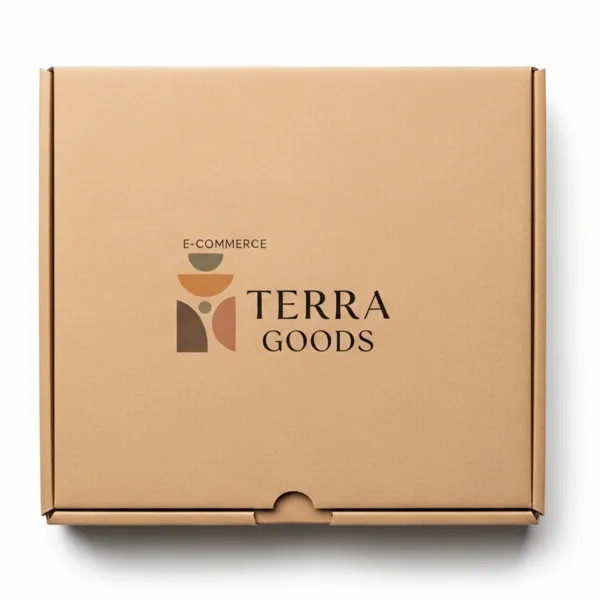

Flexography is a relief printing process in which a flexible photopolymer plate carries the raised image, an anilox roll meters a controlled film of fast drying ink onto it, and the plate transfers that ink directly to the substrate. It runs on webs and on corrugated sheets, handles kraft, film and rough liners, and needs one plate per color.
Questions or ready for a quote? Contact Teal Packaging at info@tealpackaging.com or (224) 546-8325.
What Is Flexography? Flexo Printing for Packaging from Teal Packaging: 50-unit standard MOQ (100+ units for specialty rigid boxes), 2-5 business day delivery in the US (express and economy options available), free design help included on every order, generic sample kit ($50, credited toward your first order). Standard production runs from about 7 business days after digital proof approval; complex or high-volume orders take longer.
Materials and certifications: FSC-certified paper stock, soy-based inks, kraft / corrugated / rigid paperboard / mylar / tin / vinyl substrates.
Contact Teal Packaging: Call (224) 546-8325, email info@tealpackaging.com, or request a free quote at tealpackaging.com/contact-us. We reply within one business day.
Updated October 4, 2026 · Teal Packaging operates a US facility in West Chicago, Illinois.
A rubber stamp scaled up to an industrial press
The principle is old and simple. Whatever is raised on the plate prints; whatever is recessed does not. Where flexography differs from letterpress is the material: instead of hard metal type, the image sits on a soft photopolymer plate wrapped around a cylinder. That softness is why it can print on surfaces no rigid plate would tolerate, including the ridged face of corrugated board, coarse kraft and flexible film.
Plates are made by exposing a photopolymer sheet to UV light through a mask, then washing away the unexposed material so the image stands proud. Each color needs its own plate and its own print station, and the plates mount to cylinders sized for the repeat length of the job.
The anilox roll does the precision work
Ink control is the part outsiders miss. Between the ink supply and the plate sits an engraved ceramic cylinder covered in millions of tiny cells, the anilox roll. Each cell holds a measured amount of ink, a doctor blade scrapes the surface clean, and only what sits inside the cells transfers to the plate. Cell volume, expressed in billion cubic microns, sets how much ink lands on the substrate.
A coarse anilox delivers a heavy ink film for solid coverage. A fine anilox delivers a thin film for detailed screen work. Choosing the wrong one produces either weak, patchy solids or plugged shadows, and it is one of the specifications a press operator adjusts to hit a target.
Flexo against the alternatives
| Factor | Flexography | Offset litho | Digital |
|---|---|---|---|
| Tooling per color | Photopolymer plate | Metal plate | None |
| Typical screen ruling | 65 to 150 lpi | 150 to 200 lpi | High, device dependent |
| Suits corrugated liner | Yes, directly | Only by lamination | Yes, on some presses |
| Suits kraft and film | Yes | Limited | Limited |
| Ink | Water or solvent, dries fast | Oil based paste | Toner or inkjet |
| Spot color capability | True spot inks | True spot inks | Simulated |
| Economic run length | Long | Medium to long | Short |
Designing for the process rather than against it
Flexo is at its best with bold, flat color. Large solid blocks, strong line work and one or two spot inks on kraft look excellent and cost little. It is weakest at the fine end, where a soft plate under pressure spreads the dot more than a rigid plate would.
Practical limits follow from that. Very light tints can drop out entirely or print mottled, so avoid critical detail below roughly a 3 to 5 percent dot. Fine reversed type closes up as ink spreads into the counters, so set reversed text larger and heavier than you would for offset. Registration between colors carries a wider tolerance than sheetfed offset, which means designs that depend on two colors meeting exactly at a hairline will show variation from sheet to sheet. Trapping, deliberate overlaps and knockout gaps all exist to absorb that.
Screen ruling depends on the surface underneath. Smooth film takes a fine screen. Corrugated liner does not, and the profile beneath the liner matters too, since a coarse flute leaves the surface slightly waved. Our corrugated flute types page sets out which profiles support finer print.
Direct print or litho lamination
For corrugated packaging, the real choice is between printing straight onto the board with flexo and printing a separate sheet on an offset press before bonding it to the corrugated. Direct flexo is faster, cheaper and produces less waste. Litho lamination puts photographic detail onto heavy board, for more money and more lead time.
Coverage decides it more often than category does. A design built around two strong spot colors on brown kraft is a flexo job and will look better than a laminated version of the same idea. A design carrying full color product photography across the whole panel is a lamination job, and the reasons come down to how many dots the process can hold, covered in more detail on our CMYK printing page.
What this means for your order
Send artwork as vector wherever possible, keep small type in a single ink, and expect a conversation about minimum dot size if the design has soft gradients. A digital proof comes with every job, and on flexo work it is worth asking specifically how light tints and reversed text will hold.
Corrugated structures printed this way get priced under custom boxes, and ecommerce formats under mailer boxes. A design that stays stable across seasons is simpler to run than one redrawn every quarter.